Download
1 / 14
140 likes | 271 Vues
This study evaluates the potential for creating a wetland in an open space on the NC State Centennial Campus. It explores the feasibility of a riverine wetland design that incorporates inputs from groundwater, stormwater, and overbank flow, while promoting native vegetation and wildlife habitats. Additionally, it considers pedestrian access and greenway integration. The study includes analyses of existing site conditions, potential environmental hazards, and jurisdictional issues, providing a comprehensive overview of the proposed wetland project.

E N D
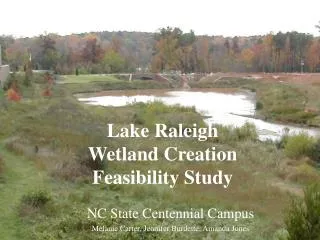
Lake Raleigh Wetland CreationFeasibility Study NC State Centennial Campus Melanie Carter, Jennifer Burdette, Amanda Jones
Project Description • Purpose • Determine if a wetland could be • created in a designated open space • on Centennial Campus • Proposed Project • Riverine Wetland Creation • --Groundwater, stormwater, and • overbank flow inputs • -- Native wetland vegetation • -- Wildlife Habitat • Pedestrian Greenway and Access • History • Stormwater pond and proposed • wetland location “built” in early 1990’s
Feasibility Study Components • Existing Conditions • Site Description and Land Use • Physical & Natural Resources • Soils • Hydrology • Vegetation • Geology • Flood Hazard • Cultural Resources
Feasibility Study Components (cont’d) • Chain-of-Title • Environmental Hazard Assessment • Jurisdictional Issues • Waters of the US (Section 404) • Protected Species • Riparian Buffers • Constraints
Existing Site Conditions Site Description & Land Use • Study Site (~2 acres) • Semi-natural landscape with • planned pedestrian trail • West Boundary • Perennial Stream and Forebay • East Boundary • Herbaceous Upland Slope
Jurisdictional Issues • Area of construction located above ordinary high water mark of perennial stream and does not contain jurisdictional wetlands • No Section 404/401 permit from US Army Corps of Engineers or NC Division of Water Quality required • Area for proposed wetland creation located within Neuse River Basin Riparian Buffer • No Neuse River Riparian Buffer Compliance required from NC Division of Water Quality
ConceptualWetland Design DETAIL Proposed Levee • Create level area east of • stream channel • Divert ephemeral • drainage through • constructed wetland • Build a low levee along • perennial channel to • detain portion of • ephemeral drainage Area to be Leveled Ephemeral Drainage
Conceptual Wetland DesignCross-section Pedestrian Trail Existing Grade Proposed Grade Seasonal High Water Table Perennial Stream
Suggested Wetland Plants Lizard’s Tail Buttonbush Spicebush Jack-in-the-Pulpit Swamp Rose Photos courtesy of USDA PLANTS Database http://plants.usda.gov/
ProjectConstraints • FEMA 100-yr Floodplain • Boundary (Red) • Sewer Line Amendments • (Blue) • Grading Costs (Gray) • Pedestrian Greenway • Access • Maintenance