
Understanding Prokaryotic and Eukaryotic Cells: Key Differences and Similarities
Explore the fundamental differences and similarities between prokaryotic and eukaryotic cells in this informative guide. Discover how prokaryotes, the simplest cellular organisms like bacteria, differ from more complex eukaryotic cells found in animals, plants, fungi, and protists. Learn about their structure, including the presence of nuclei, membrane-bound organelles, and cell walls. The evolution of life on Earth, from the emergence of prokaryotic cells over 3.5 billion years ago to the rise of multicellular eukaryotes, is also discussed.

Understanding Prokaryotic and Eukaryotic Cells: Key Differences and Similarities
E N D
Presentation Transcript
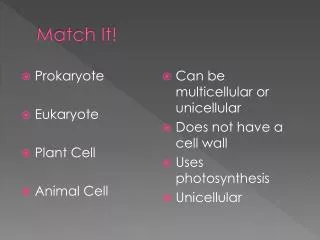
Match It! • Prokaryote • Eukaryote • Plant Cell • Animal Cell • Can be multicellular or unicellular • Does not have a cell wall • Uses photosynthesis • Unicellular
"Karyose" comes from a Greek word which means "kernel," as in a kernel of grain. In biology, we use this word root to refer to the nucleus of a cell. • "Pro" means "before," and "eu" means "true," or "good." Prokaryotic cells have no nuclei, while eukaryotic cells do have true nuclei.
Similarities • There are four major similarities between prokaryotic and eukaryotic cells • 1. DNA, the genetic material contained in one or more chromosomes and located in a nonmembrane bound nucleoid region in prokaryotes and a membrane-bound nucleus in eukaryotes
Similarities • 2. Plasma membrane, a phospholipidbilayer with proteins that separates the cell from the surrounding environment and functions as a selective barrier for the import and export of materials
Similarities • 3. Cytoplasm, the rest of the material of the cell within the plasma membrane, excluding the nucleoid region or nucleus, that consists of a fluid portion called the cytosol and the organelles and other particulates suspended in it
Similarities • 4. Ribosomes, the organelles on which protein synthesis takes place
Features of a Prokaryotic Cell • Prokaryotes, which include all bacteria and archaea (archaebacteria), are the simplest cellular organisms. • Prokaryotic cells are fundamentally different from eukaryotic cells. Notably, prokaryotic cells lack a nucleus and membranous organelles.
Features of a Prokaryotic Cell • The walls of bacteria consist of peptidoglycans. Sometimes there is also an outer capsule. • Some bacteria have flagella which are used for locomotion and/or pili, which may be used to pull two cells in close contact
Features of a Eukaryotic Cell • Eukaryotic cells contain a membrane-bound nucleus and numerous membrane-enclosed organelles not found in prokaryotes. • The nucleus is bounded by the nuclear envelope, a double membrane with many nuclear pores through which material enters and leaves. Animals, plants, fungi, and protists are all eukaryotes. Eukaryotic cells are more complex than prokaryotic cells.
Age Differences • 4.6 billion years ago the Earth was formed • 3.5 billion years ago the first life arose: prokaryotic bacteria • 1.5 billion years ago eukaryotic cells arose • 0.5 billion years ago the Cambrian explosion – multi-celled eukaryotes arose • 3 million years ago our earliest ancestors, the hominids, appeared
Size Differences • Eukaryotes are, on average, 10 times the size of prokaryotes
