Understanding Financing Rounds: Key Considerations for Startups
90 likes | 208 Vues
This guide explores the essentials of startup financing rounds, detailing the amount of cash needed, the capital sources, and the deal structure. It answers two critical questions: how much money is required for this financing round, and which risks are mitigated? The document outlines various financing stages like Seed, Early, and Mezzanine, alongside insights into sources of capital including angel investors and venture capitalists. Also covered are important deal questions, including ownership percentages and compensation terms to investors, illustrated with a clear venture finance example.


Understanding Financing Rounds: Key Considerations for Startups
E N D
Presentation Transcript
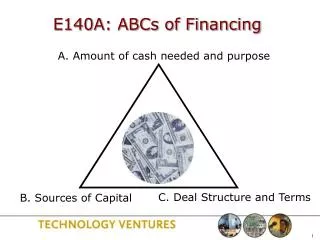
E140A: ABCs of Financing A. Amount of cash needed and purpose C. Deal Structure and Terms B. Sources of Capital
A. Amount of Cash …Two Key Questions #1 How much money is needed for this “round” of financing? Typical Financing Stages (or Rounds): Seed Early Mezzanine Late (e.g., IPO)
#2 Which risks are to be reduced with this money in this round? Team Risk Technology Risk Capital Risk Market Risk
Angel Investors Corporate VC Traditional VC Boot-strapping Other B. Raise Money From Where?Sources of Capital for High-Technology Entrepreneurs
U.S. Venture Capital Investment Number of US VC Investments In 2003, VC’s invested $18 billion in U.S. and angels invested about $16 billion. (Sources: Venture Economics, NVCA and Center for Venture Research)
C. Key Questions Regarding the “Deal” • What percentage of the company do the investors receive for their cash? • What special terms and conditions are necessary to compensate them for the risk?
A Simple Venture Finance Example • Roma’s hot startup requires $10 million in order to form its business. She expects to earn $10 million in its fifth year. • Randy’s VC firm has reviewed the company's business plan and believes that he is entitled to a 50% return on his investment. (Hint: how many “times” must his money grow in 5 years?) • Publicly traded companies in this category and industry trade at approximately 15 times earnings (PE ratio). There is no material difference between these companies and the startup. • What portion of the company should Randy’s VC firm receive today? (Hint: what is future value of that investment?) 1. Value of VC Investment in Year 5 = $10 m*(1+50%)^5 = $76m 2. StartUp’s Value in Year 5 = $10 m*(P/E of 15) = $150m 3. VC Firm’s Share Today = Step 1/Step 2 = $76 m/$150m = ~ 50% 4. “Post-Money” Value Today = $10 m / .50 =$ 20 mm
1mm shares for each founder =3mm shares @ $0.001 ea. Value=$3k +1mm shares each for CEO & employees = 5mm shares @ $0.01 each Value=$50k +5mm shares for first VC firm =10mm shares @ $1.00 each Value=$10mm Use of $: R&D A Multi-Stage Venture Finance Example Time I II III IV V Note: not to scale
+5mm shares for second round VCs =15mm shares @ $5 each Value=$75mm Use of $: Mktg. +5mm shares for sale to public in IPO = 20mm shares @ $15.00 each Value=$300mm Use of $: Operations A Multi-Stage Venture Finance Example Time I II III IV V V 1mm shares each for CEO & employees = 5mm shares @ $0.01 each Value=$50k 5mm shares for first VC firm =10mm shares @ $1.00 each Value=$10mm Use of $: R&D 1mm shares for each founder =3mm shares @ $0.001 ea. Value=$3k Note: not to scale