Internetworking and Architecture
This document covers critical aspects of computer networks in CST 415, focusing on internetworking, internet addressing, and application-layer communications. Key topics include the definitions and mechanisms behind application gateways, message-level routing, and forwarding processes. It emphasizes the decoupling of applications from network details, enabling flexible network topologies, and discusses challenges like IP addressing and classful address structures. The role of intermediate computers, network technology upgrades, and the nature of the internet as a growing, standardizing entity are also examined.

Internetworking and Architecture
E N D
Presentation Transcript
Internetworking and Architecture CST 415 CST 415 - Computer Networks
Topics • Definitions • Internetworking • Internet Addressing • The Endians Revisited CST 415 - Computer Networks
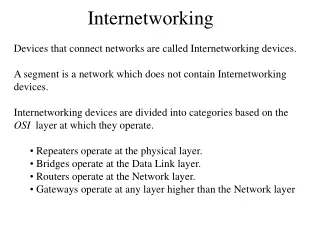
Definitions Application Gateway Message level routing and forwarding is done by a layer of software integrated into the application itself. Network Level Interconnect Messages are delivered from source to destination without the intervention of any end user application programs. • decouples applications from network details. • Intermediate computers know nothing about end user applications. • Topology of networks is flexible. • Network technology can be upgraded without impacting end-to-end application interoperation. Internetworking Detaching application level communications from details of networking technologies and detaching networking technologies from physical transmission technologies. CST 415 - Computer Networks
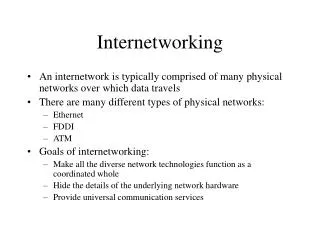
Internetworking • Provide an economical and fast media for transmission of information. • Provide communication between two arbitrary end points. • Insulate individual implementations from the system as a whole. • Provide a well defined and unified set of communication services. • Allow applications to be distributed across multiple computers in multiple locations. CST 415 - Computer Networks
Internetworking Internetworking is controlled chaos where control is allowed because of careful specification and eventual standardization. The Internet grows unbounded with no global architect. Q: Is the Internet void of problems? Even the best laid plans of mice and men Often go astray And leave us nothing but grief and pain For promised joy - Robert Burns “To a Mouse” (paraphrased) CST 415 - Computer Networks
Internetworking This is a fractal. CST 415 - Computer Networks
Internetworking CST 415 - Computer Networks
Internetworking Internetworking Explanation – From Stallings • See Stallings Figure 8 • See Stallings Figure 9 • See Stallings Figure 10 CST 415 - Computer Networks
Internet Addresses • Internet addresses (IP addresses) are 32 bit addresses. • The bits are organized to optimize routing. • The address is split up into: • Net Identifier : Identify the network on which the host resides. • Host Identifier : Identify the host on the particular network. CST 415 - Computer Networks
Internet Classful Addresses CST 415 - Computer Networks
Internet Classful Addresses • Class A address • 1 bit to identify the class (0 – class A, 1 – class B, C, D, or E) • 7 bits for net ID : There can only be 128 of these in the world. • 24 bits for host ID : Each network can have 16,777,216 host computers. CST 415 - Computer Networks
Internet Classful Addresses • Class B address • 2 bits to identify the class (10 – class B, 11 – class C, D, or E) • 14 bits for net ID : There can be 16,384 of these networks. • 16 bits for host ID : Each network can have 65,536 host computers. CST 415 - Computer Networks
Internet Classful Addresses • Class C address • 3 bits to identify the class (110 – class C, 111 – class D, or E) • 21 bits for net ID : There can be 2,097,152 of these networks. • 8 bits for host ID : Each network can have 254 host computers – 0 == network, 255 – IP Broadcast. CST 415 - Computer Networks
Internet Classful Addresses • Class D address Class D addresses are multicast addresses. 28 bits for these addresses – 268,435,456 addresses available. CST 415 - Computer Networks
Internet Classful Addresses • Class E address Class E addresses are reserved for future use and the bit structure has not yet been defined. CST 415 - Computer Networks
Internet Classful Addresses • Internet addresses do not address the host computer, they address the host-to-network connection. • Specify a host • Specify a computer • A host ID of all zeros is reserved to refer to the network. • A host ID of all ones is reserved for broadcast. • How can the address be used to specify broadcast on a specific network? CST 415 - Computer Networks
Internet Classful Addresses • The use of all zeros in an address field means “this”. • All zeros in a host field means “this” host. • All zeros in a network address means “this” network. • Can be used in the instance that a host does not know the network address. • Hopefully, any reply will have the full network address. CST 415 - Computer Networks
Internet Classful Addresses • Problems • Mobile host machines must be able to change their IP addresses. • What happens to a network when machine #256 needs to be added. • In packet routing, the route taken to a destination host is dependent on the netid. • More on these problems later. CST 415 - Computer Networks
Internet Addresses Dotted Decimal Notation Address: 10000000 00001010 00000010 00011110 is written: 128.10.2.30 CST 415 - Computer Networks
Internet Addresses Class Lowest Address Highest Address A 1 . 0 . 0 . 0 126 . 0 . 0 . 0 B 128 . 1 . 0 . 0 191 . 255 . 0 . 0 C 192 . 0 . 1 . 0 223 . 255 . 255 . 0 D 224 . 0 . 0 . 0 239 . 255 . 255 . 255 E 240 . 0 . 0 . 0 255 . 255 . 255 . 254 The range of dotted decimal values that correspond to each IP address class. Some values are reserved for special purposes. CST 415 - Computer Networks
Internet Addresses Loopback Address: • The loopback address allows the protocol stack to keep a packet destined for the local machine off the network. • This address can be used for inter-process communication using the TCP/IP protocol stack. • The address is 127.0.0.1 • Using this address avoids propagating a packet onto the network hardware. CST 415 - Computer Networks
Internet Addresses Reserved Private Addresses: • 10.0.0.0 to 10.255.255.255 • 172.16.0.0 to 172.31.255.255 • 192.168.0.0 to 192.168.255.255 and as of July 2001 • 169.254.0.0 to 169.254.255.255 CST 415 - Computer Networks
Internet Addresses The IANA (Internet Addressing Number Authority) • Administered by a single person “John Postel” until his death in 1998 • After John died, an organization was formed to administer the addresses. • A new organization was defended to deal with this called ICANN (Internet Corporation for Assigned Names and Numbers) • The job of ICANN is to deal with the assignment of names and numbers in Internet addressing. CST 415 - Computer Networks
The Endians • Network byte order is “big endian” • largest byte in a multibyte item sent first • these bytes read naturally on a piece of paper : left to right. • big-endian is basically every processor type but Intel. • Intel processors are little endian (least significant byte first) • Intel processors must swap bytes when reading data from a standard network connection. CST 415 - Computer Networks