Behavioral Emergencies
Behavioral emergencies often stem from various factors, leading to noticeable changes in behavior that disrupt daily living. Contrary to beliefs, anyone can show symptoms of mental health issues, and only a small fraction may become violent. This chapter discusses the definitions of behavioral crises, common causes like organic brain syndrome and functional disorders, and essential safety guidelines for responders. It emphasizes the need for a careful approach, ongoing assessment, and understanding of risks such as suicide. Knowing these elements aids in effective intervention during critical situations.

Behavioral Emergencies
E N D
Presentation Transcript
Behavioral Emergencies Chapter 19
Myth and Reality • Everyone has symptoms of mental illness problems at some point. • Only a small percentage of mental health patients are violent. • Perfectly healthy people may have symptoms occasionally.
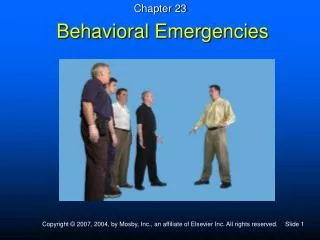
Defining Behavioral Emergencies • Behavior • What you can see of a person’s response to the environment and his or her actions • Behavioral crisis • Any reaction to events that interferes with activities of daily living or that becomes unacceptable to the patient, family, or others • A pattern, not an isolated incident
Causes of Behavioral Emergencies • Organic Brain Syndrome • Caused by disturbance in brain tissue function • Functional Disorder • Cannot be traced to change in structure or physiology of the brain
Causes of Organic Brain Syndrome • Sudden illness • Recent trauma • Drug or alcohol intoxication • Diseases of the brain • Low blood glucose • Lack of oxygen • Inadequate blood flow to the brain • Excessive heat or cold
Safety Guidelines • Be prepared to spend extra time. • Have a plan of action. • Identify yourself. • Be calm. • Be direct. • Assess the scene. • Stay with patient. • Encourage purposeful movement. • Express interest. • Do not get too close. • Avoid fighting. • Be honest and reassuring. • Do not judge.
Scene size up • Scene safety is most important. Consider calling appropriate resources if needed. • Take BSI precautions at all times. • Avoid tunnel vision.
Initial Assessment • Start from the doorway. • State why you are there. • Be calm and relaxed. • Provide appropriate interventions. • Transport to appropriate facility based on condition.
Focused history and physical exam • If unconscious, do rapid exam for life threats. • Assess three major areas as contributors: • Is patient’s CNS functioning properly? • Are hallucinogens or other drugs or alcohol a factor? • Are psychogenic circumstances, symptoms, or illness involved? • Use reflective listening: repeating what the patient has said in question form to help patient expand thoughts.
Focused Physical Exam • Use facial expressions, pulse, and respirations to help make determination. • Tears, sweating, blushing may be indicators. • Look at patient’s eyes. • Coping mechanisms are stressed; perception of reality may be distorted.
Interventions • Be caring and careful. • Intervene only to safely transport. • Detailed Physical Exam is rarely called for
Ongoing Assessment • Never let your guard down. • Use law enforcement personnel with transport if available. • Give advance warning to hospital. • Can involve legal matters; document clearly and well. • Be clear and specific on restraint use.
Suicide • Depression is the single most significant factor that contributes to suicide. • An attempted suicide is a cry for help. • Immediate intervention is necessary. • Suicidal patients will usually exhibit warning signs.
Critical Warning Signs of Suicide • Does the patient have an air of tearfulness, sadness, deep despair, or hopelessness? • Does the patient avoid eye contact, speak slowly, or project a sense of vacancy? • Does the patient seem unable to talk about the future? • Is there any suggestion of suicide? • Does the patient have any specific plans relating to death?
Additional Risk Factors for Suicide • Are there any unsafe objects in the patient’s hands or nearby? • Is the environment unsafe? • Is there evidence of self-destructive behavior? • Keep in mind the suicidal patient may be homicidal as well.
Medicolegal Considerations • Mental incapacity may take many forms. • Once a patient has been determined to have an impaired mental capacity, you must decide if care is needed. • Do not leave the patient alone. • Obtain help from law enforcement as necessary.
Consent • When a patient is not mentally competent, the law assumes that there is implied consent. • The matter is not always clear-cut with psychiatric emergencies. • If you are not sure about the situation, request law enforcement assistance.
Limited Legal Authority • As an EMT-B, you have limited legal authority to require or force a patient to undergo care. • Police may put a patient in protective custody to allow you to provide care. • Know your local laws and protocols.
Restraints • You cannot restrain a patient unless it is an emergency. • Transport a disturbed patient without restraints if possible. • If you must restrain the patient, use only reasonable force. • Law enforcement personnel should be involved.
Potentially Violent Patients • Use a list of risk factors to assess the level of danger: • Past history • Posture • Scene • Vocal activity • Physical activity
Other Factors to Consider for Potential Violence • Poor impulse control • History of uncontrollable temper • Low socioeconomic status • Substance abuse • Depression • Functional disorders