Rapid Port Enhancement for Theater Support Vessels: Overview and R&D Initiatives
This document outlines the Army's Rapid Port Enhancement (RPE) initiative aimed at improving port capabilities for Theater Support Vessels (TSVs). It highlights current funding levels, ongoing R&D efforts, and key milestones achieved since FY03. The RPE encompasses the development of lightweight modular causeways, small sea port characterization methodologies, and throughput models, aiming to enhance operational efficiency. Future efforts include near-shore breakwater development and rapid pier upgrades, emphasizing a holistic approach to port enhancement and security.

Rapid Port Enhancement for Theater Support Vessels: Overview and R&D Initiatives
E N D
Presentation Transcript
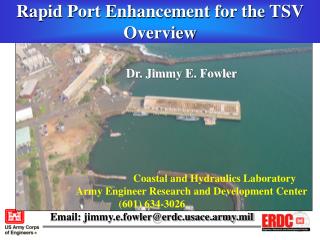
Rapid Port Enhancement for the TSVOverview Dr. Jimmy E. Fowler Coastal and Hydraulics Laboratory Army Engineer Research and Development Center (601) 634-3026 Email: jimmy.e.fowler@erdc.usace.army.mil
Rapid Port Enhancement for the TSV • New Army Science and Technology Objective (STO # IV.EN.2003.04) • Presently only funded at 6.2 level • 4 year effort started in FY 03 Sponsor Agencies: DPMO, MSBL
RPE Team • Coastal & Hydraulics Laboratory – ERDC • Geotechnical & Structures Laboratory – ERDC • Quantum Engineering Design, Inc • Alion Inc.
RPE R&D Program This is our Focus
RPE R&D Components RPE R&D Components Presently Funded Efforts: Lightweight Modular Causeway Development Small Sea Port Characterization Methodology Throughput Model Development Proposed Unfunded Efforts: Near Shore Breakwater Expedient Dredging Rapid Pier Repair/Upgrade Waterside Security
RPE R&D Major Milestones Rapid Port Enhancement for the Theater Support Vessel FY04: Small Scale Lab Demonstration FY 04 Integration of Egress/Ingress Port Algorithms FY05: Fabrication of Scaled Causeway Model for Field Demo Integration of Algorithms into Small Port Throughput Model FY06: Scaled Field Demonstration of Causeway System and Modeling Capabilities/Small Port Tool-kit FY06: Lightweight Causeway System ready for full scale (6.3) program/demonstration
Throughput Model Development POCs: Green, Debra and Greg Key Milestones: ’03 Cluster Analysis of Small Ports ’04 Computational framework for land/sea-based throughput analysis ’05 Link sea/land modules for Small Port Throughput Model ’06 Validate Small Port Throughput Model Small Port ThroughputModel
Small Port Characterization Methodology POC: Dr. Resio Key Milestones: ’04 Small Port Characterization/Classification System (SMPCCS) ’05 Inferential System for Applying SMPCCS when data is lacking ’06 Small Port Classification/Assessment Module
Lightweight Modular Causeway Section Development POCs: Resio, Donald Fowler, Jimmy Pratt, James Ray, James Bevins, Tommy Plackett, Mike • Many more small/medium ports available to TSV/HSV/HSC • Many will not be immediately offload compatible and will require upgrade or access improvements • Existing/planned causeway systems not transportable by TSV
LMCS Comparison 80 ft MCS 60 ft LMCS LMCS = 23% of the MCS storage volume = 33% of the MCS Weight =100% of the MCS payload capacity
Force Projection Lightweight Modular Causeway Development POC: Resio/Fowler/Ray Planned Accomplishments with existing funds: FY04: Small Scale Lab/Field Demonstration FY05: Fabrication of Small Scale Causeway Model for Field Study FY06: Small-Scale Field Demonstration of Causeway System and Modeling Capabilities FY06: LMCS ready for transition to 6.3 Full Scale Development FY09: Transition to SDD FY10: Initial procurement of Lightweight Modular Causeway System Other scenarios could accelerate procurement schedule
Concept Still Needs Work! • Puncture/Wear Resistance • Roll Stability • Deployment/Recovery • Ramps and Ramp Loads • Mooring • Trafficability/Wear Surface • TSV-Interface Issues • Life-Cycle Costs • Force Structure Issues
Pratt: Design Considerations Bevins: Superstructure Concepts Plackett: Substructure Concepts Photo: Duck, NC by D. Green