Understanding Gas Laws: Boyle’s, Charles’, and Gay-Lussac’s Contributions
This lecture delves into the fundamental gas laws, highlighting Boyle’s Law, Charles’ Law, and Gay-Lussac’s Law. It explains the relationships between pressure, volume, and temperature in gases, noting how they evolve into the Ideal Gas Law (PV=nRT). Emphasis is placed on using the Kelvin scale for temperature and understanding the kinetic theory of gases. The lecture also explores real versus ideal gases and the significance of Avogadro's number in molecular interpretation. Ideal for students seeking a solid grasp of thermodynamic principles.

Understanding Gas Laws: Boyle’s, Charles’, and Gay-Lussac’s Contributions
E N D
Presentation Transcript
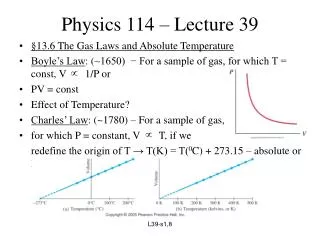
Physics 114 – Lecture 39 • §13.6 The Gas Laws and Absolute Temperature • Boyle’s Law: (~1650) − For a sample of gas, for which T = const, V 1/P or • PV = const • Effect of Temperature? • Charles’ Law: (~1780) – For a sample of gas, • for which P = constant, V T, if we redefine the origin of T → T(K) = T(0C) + 273.15 – absolute or Kelvin scale L39-s1,8
Physics 114 – Lecture 39 • Gay-Lussac’s Law: (~1820) −For a sample of gas, for which V = const, P T, where T is in kelvins (K) • Study Example 13.9 • §13.7 The Ideal Gas Law • PV T • Amount of gas? Expt.: if P and T are const, V m • PV mT • Constant? → PV = α RT, where α depends on m • It turns out that α is conveniently expressed in moles L39-s2,8
Physics 114 – Lecture 39 • E.g., the number of moles in 96.0 g of O2 for which the molecular mass is 2 X 16.0 = 32.0 • The Ideal Gas Law then becomes, • PV = nRT where R = 8.314 J/(mol. K) where R is the universal gas const and is the same for all gases L39-s3,8
Physics 114 – Lecture 39 • Reminder: P is the absolute pressure and T, the temperature, is measured in kelvins • Of course real gases, as opposed to ideal gases, follow this law only when they are neither at very high pressures nor near their liquefaction point • §13.8 Problem Solving with the Ideal Gas Law • Study Problems 13.10, 13.11, 13.12 and 13.13 L39-s4,8
Physics 114 – Lecture 39 • §13.9 Ideal Gas Law in Terms of Molecules: Avogadro’s Number • Avogadro’s Hypothesis: Equal volumes of gas at the same temperature and pressure contain equal numbers of molecules • This is consistent with R being the same for all gases • Thus: PV = nRT states that, if P, V and T are the same for samples of two different gases, then n must be the same for these gases since R has the same value for all gases and the number of molecules in 1 mole is the same for all gases L39-s5,8
Physics 114 – Lecture 39 • The number of molecules in one mole of any pure substance is given by Avogadro’s number, NA • The accepted value is: • NA = 6.02 X 10²³ molecules/mole • We have PV = nRT = • which may be written, PV = N k T • where • and where k is known as the Boltzmann constant L39-s6,8
Physics 114 – Lecture 39 • §13.10 Kinetic Theory and the Molecular Interpretation of Temperature • Assumptions: • 1. Large number of mols each of of mass, m, moving randomly • 2. Mols on average far apart wrt their diameter – force between mols = 0, unless they are colliding • 3. Mols interact only when they collide and follow laws of classical mechanics • 4. Collisions with the container walls are elastic and of short duration, compared with time between collisions L39-s7,8
Physics 114 – Lecture 39 x vx • Consider one molecule colliding with the wall Δp1 = -mv1x – (mv1x) = -2 mv1x for mol Δt = 2l/v1x F1 = Δp1/Δt = -2mv1x/ (2l/v1x) = -mv1x2/l For N molecules, total force on wall F = (m/l) (v1x2 + v2x2 + v3x2 + … + vNx2) Since v1x2 + v2x2 + v3x2 + … + vNx2 = N (vx2)ave F = (m/l) N (vx2)ave With (vx2)ave = v2ave /3 → P = F/A = ⅓ Nm v2ave /(Al) With V = Al → PV = ⅓ Nm v2ave = ⅔N(½ mv2ave) = ⅔N KEave Comparing with PV = NkT → KEave = ½ mv2ave = (3/2) kT Thus T is a measure of KEave of the molecules in the sample -vx l L39-s8,8