Understanding Equations of Motion for Horizontally Launched Projectiles and Angled Launches
20 likes | 158 Vues
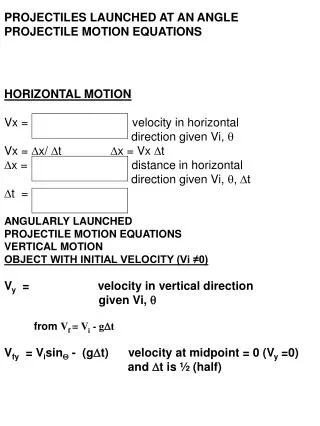
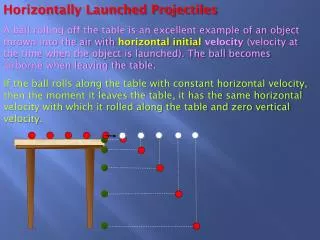
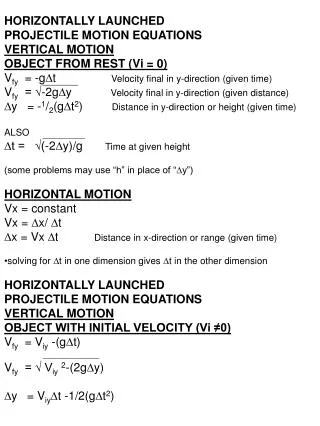
This guide covers the fundamental equations governing the motion of projectiles launched both horizontally and at an angle. For horizontally launched projectiles, we explore relationships such as horizontal displacement (Δx = VxΔt) and vertical displacement (Δy = +½g•(Δt)²). For angled launches, we delve into the components of initial velocity (Vi), with equations for displacement, final velocity, and their relationships. Understanding these concepts is essential for analyzing projectile motion in physics and engineering contexts.


Understanding Equations of Motion for Horizontally Launched Projectiles and Angled Launches
E N D
Presentation Transcript
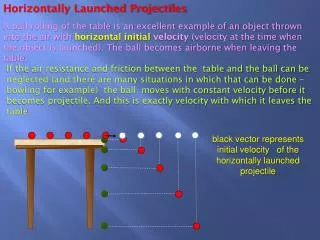
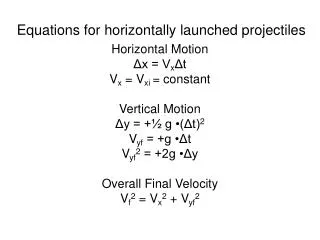
Equations for horizontally launched projectiles Horizontal Motion Δx = VxΔt Vx = Vxi = constant Vertical Motion Δy = +½ g •(Δt)2 Vyf = +g •Δt Vyf2 = +2g •Δy Overall Final Velocity Vf2 = Vx2 + Vyf2
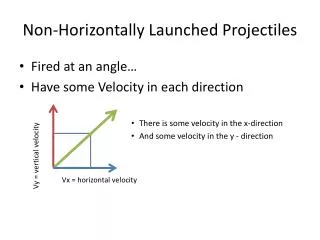
Equations for Projectiles Launched at an Angle Δx = Vi (cosθ) •Δt Vxi = Vi (cosθ) remains constant Vyi = Vi(sinθ) Δy = Vi(sinθ) • Δt + ½ g •(Δt)2 Vyf = Vi(sinθ) + g •(Δt) Vyf2 = Vi2(sinθ)2 + 2g •(Δy) Overall Final Velocity Vf2 = Vx2 + Vyf2