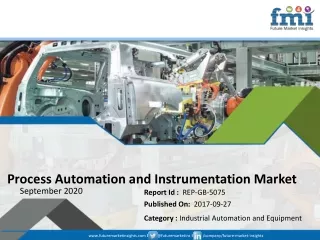
Sales of Process automation and instrumentation to Decelerate in 2020 as COVID-19 Pandemic Takes its Toll on Global Mark
Future Market Insights (FMI) offers a 10-year forecast of the Process automation and instrumentation market between 2017 and 2027. In terms of value, the process automation and instrumentation market is expected to register a single digit CAGR during the forecast period. This study demonstrates the global dynamics of process automation and instrumentation market and trends across seven regions, namely North America, Latin America, Western Europe, Eastern Europe, APEJ, Japan and MEA, which influence the current nature and future status of the process automation and instrumentation market over the forecast period. Report Description This research report provides a detailed analysis of the process automation and instrumentation market and offers insights on the various factors driving the popularity of process automation and instrumentation market. The report includes an extensive analysis of the key industry drivers, challenges, market trends and market structure. The market study provides a comprehensive assessment of stakeholder strategies and imperatives for succeeding in the business. The process automation and instrumentation market report segregates the market based on technology, application and different regions globally. The process automation and instrumentation market is expected to witness steady value growth during the forecast period owing to an increase in the demand for Industrial Internet of Things (IIoT) and data-driven technologies by various industry verticals. Sample of Research Report @ https://www.futuremarketinsights.com/reports/sample/rep-gb-5075 The report starts with an overview of the process automation and instrumentation market in terms of value. In addition, this section includes an analysis of key trends, drivers and challenges from the supply, demand and economy side, which are influencing the process automation and instrumentation market. The process automation and instrumentation market is classified on the basis of instrument type, solutions, application, and region. By instrument type, the process automation and instrumentation market is sub-segmented into transmitters, flow meters, analysers, controllers, switches, recorders, switches, and vacuum instruments. By solutions, the global process automation and instrumentation market is segmented in to PLC, SCADA, DCS, HMI, APC, MES, and safety automation. Furthermore, by application, the global process automation and instrumentation market is segmented into chemical, metal & mining, food & beverage, oil & gas, pharmaceutical, pulp & paper, wastewater treatment, power, and others. The chemical sub-segment accounted for a relatively higher share owing to an increase in the demand due to technological advancements in the chemical industry worldwide. A detailed analysis has been provided for every segment in terms of market size analysis for the process automation and instrumentation market across different regions. This section provides a detailed analysis covering the key trends. The next section contains a detailed analysis of the process automation and instrumentation market across various countries in the region. It provides a market outlook for 2017u20132027 and sets the forecast within the context of the process automation and instrumentation market, which includes latest technological developments as well as offerings in the market. This study discusses the key trends within countries contributing to growth of the process automation and instrumentation market as well as analyses the degrees at which drivers are influencing the process automation and instrumentation market in each region. The key regions and countries assessed in this report include North America (U.S., Canada), Latin America (Brazil, Mexico & Rest of Latin America), Western Europe (UK, France, Germany, Spain, BENELUX, and Rest of Western Europe), Eastern Europe (Russia, Poland & Rest of Eastern Europe), APEJ (India, China, ASEAN, and Rest of APEJ), Japan, and MEA (GCC Countries, Turkey, South Africa, and Rest of MEA). This report evaluates the present scenario and the growth prospects of the process automation and instrumentation market across various regions globally for the period 2017 u20132027. We have considered 2016 as the base year and provided data for the remaining 12 months. To offer an accurate forecast, we started by sizing the current process automation and instrumentation market, which forms the basis of how the process automation and instrumentation market will grow in the future. Given the characteristics of the market, we have triangulated the outcome of different types of analysis based on the technology trends. As previously highlighted, the global process automation and instrumentation market is split into a number of segments. All the segments in terms of instrument type, solution, application, and different regions are analysed in terms of basis points to understand the relative contributions of individual segments to market growth. This detailed information is important for the identification of various key trends in the global process automation and instrumentation market. In addition, another key feature of this process automation and instrumentation market report is the analysis of all key segments in terms of absolute dollar opportunity. This is traditionally overlooked while forecasting the market. However, absolute dollar opportunity is critical in assessing the level of opportunity that a provider can look to achieve, as well as to identify potential resources from a sales and delivery perspective in the global process automation and instrumentation market. In the final section of the process automation and instrumentation market report, we have included a competitive landscape to provide clients a dashboard view based on the categories of providers in the value chain, their presence in the process automation and instrumentation market and key differentiators. This section is primarily designed to provide clients an objective and detailed comparative assessment of key providers specific to a market segment in the process automation and instrumentation supply chain and the potential players for the same. Report audiences can gain segment-specific vendor insights to identify and evaluate key competitors based on an in-depth assessment of their capabilities and success in the marketplace. Detailed profiles of providers are also included in the scope of the report to evaluate their long-term and short-term strategies, key offerings and recent developments in the process automation and instrumentation market. Examples of some of the key competitors of the process automation and instrumentation market are ABB Limited, Emerson Electric Company, Mitsubishi Electric Company, Rockwell Automation Inc., Siemens AG, Schneider Electric SE, Yokogawa Electric Corporation, Honeywell International Inc., and Pepperl Fuchs GmbH. Key Segments By Instrument Type Transmitters Flow meters Analysers Controllers Switches Recorders Switches Vacuum instruments By Solution PLC SCADA DCS HMI APC MES Safety Automation By Application Chemical Metal & mining Food & beverage Oil & gas Pharmaceutical Pulp & paper Wastewater treatment Power Safety Automation To Buy This Research Report @ https://www.futuremarketinsights.com/checkout/5075 Key Companies ABB Limited Emerson Electric Company Mitsubishi Electric Company Rockwell Automation Inc. Siemens AG Schneider Electric SE Yokogawa Electric Corporation Honeywell International Inc. Pepperl Fuchs GmbH ABOUT US: Future Market Insights is the premier provider of market intelligence and consulting services, serving clients in over 150 countries. FMI is headquartered in London, the global financial capital, and has delivery centers in the U.S. and India. FMIu2019s research and consulting services help businesses around the globe navigate the challenges in a rapidly evolving marketplace with confidence and clarity. Our customized and syndicated market research reports deliver actionable insights that drive sustainable growth. We continuously track emerging trends and events in a broad range of end industries to ensure our clients prepare for the evolving needs of their consumers. CONTACT US: Mr. Abhishek Budholiya Unit No: AU-01-H Gold Tower (AU), Plot No: JLT-PH1-I3A, Jumeirah Lakes Towers, Dubai, United Arab Emirates MARKET ACCESS DMCC Initiative For Sales Enquiries: sales@futuremarketinsights.com For Media Enquiries: press@futuremarketinsights.com
131 views • 12 slides