
Electric Field at the Origin from a Charged Eighth-Circle Rod
This problem examines the electric field created at the origin by a positively charged rod bent into an eighth of a circle, with radius ( a ) and total charge ( +Q ) uniformly distributed along its length. The formulation employs principles of electrostatics, utilizing infinitesimal charge elements and trigonometric relationships to derive the electric field components. Additionally, it explores the effects of introducing a negative point charge at the origin and considers alterations when adjusting the arrangement of the charge configuration.

Electric Field at the Origin from a Charged Eighth-Circle Rod
E N D
Presentation Transcript
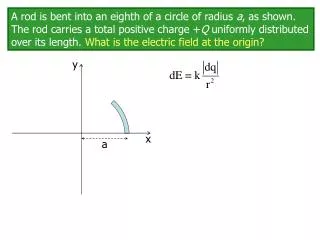
A rod is bent into an eighth of a circle of radius a, as shown. The rod carries a total positive charge +Q uniformly distributed over its length. What is the electric field at the origin? y x a
A rod is bent into an eighth of a circle of radius a, as shown. The rod carries a total positive charge +Q uniformly distributed over its length. What is the electric field at the origin? y dq x a dE
A rod is bent into an eighth of a circle of radius a, as shown. The rod carries a total positive charge +Q uniformly distributed over its length. What is the electric field at the origin? y d ds x a dE
A rod is bent into an eighth of a circle of radius a, as shown. The rod carries a total positive charge +Q uniformly distributed over its length. What is the electric field at the origin? y dq x a dE
A rod is bent into an eighth of a circle of radius a, as shown. The rod carries a total positive charge +Q uniformly distributed over its length. What is the electric field at the origin?
A rod is bent into an eighth of a circle of radius a, as shown. The rod carries a total positive charge +Q uniformly distributed over its length. What is the electric field at the origin?
A rod is bent into an eighth of a circle of radius a, as shown. The rod carries a total positive charge +Q uniformly distributed over its length. What is the electric field at the origin? You should provide reasonably simplified answers on exams, but remember, each algebra step is a chance to make a mistake.
What would be different if the charge were negative? What would you do differently if we placed a second eighth of a circle in the fourth quadrant, as shown? y x a
A rod is bent into an eighth of a circle of radius a, as shown. The rod carries a total positive charge +Q uniformly distributed over its length. A negative point charge -q is placed at the origin. What is the electric force on the point charge? Express your answer in unit vector notation. You could start with Coulomb’s Law, re-write it to calculate the dF on q1=-qdue to dq2 (an infinitesimal piece of the rod), and then integrate over dq2. In other words, do the whole problem all over again. y -q x Or you could multiply the two slides back by –q, simplify if appropriate, and be done with it. a