Download
1 / 23
230 likes | 366 Vues
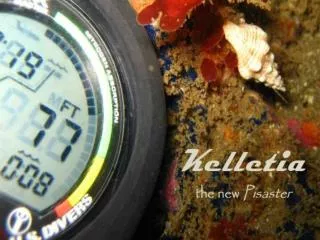
This report presents preliminary results on the changes in floating kelp canopy areas in the Elwha River ecosystem from 1989 to 2012. Significant reductions were noted in various key locations, highlighting the impact of sedimentation and human activities on kelp health. Utilizing underwater videography and aerial photography, researchers assessed kelp populations, revealing trends in canopy area influenced by climatic conditions like El Niño and La Niña. Ongoing analysis aims to deepen understanding of these critical marine habitats for effective conservation strategies.

E N D
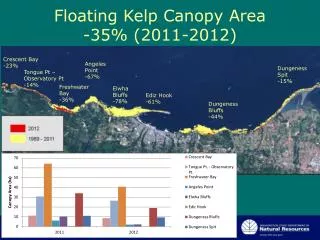
Floating Kelp Canopy Area-35% (2011-2012) Crescent Bay -23% Angeles Point -67% Dungeness Spit -15% Tongue Pt – Observatory Pt -14% Freshwater Bay -36% Elwha Bluffs -78% Ediz Hook -61% Dungeness Bluffs -44%
After - 2012 Before - 2010 Directly east of the Elwha River mouth, -8 m (MLLW).
Tran 1 .94 .06 .80 Tran 2 .80 .42 .48 Tran 3 .66 .40 Tran 4 .90 .48 1 2 Tran 5 3 .78 .64 5 4
Changes in Kelp Near the Elwha River Preliminary Results After Dam 1989-2010 (DNR) Helen Berry DNR Nearshore Habitat Program
Acknowledgements • 2010 underwater videography • Cathy Lear, Clallam County • Jim Norris, Marine Resource Consultants • Floating kelp data collection and mapping • Bob VanWagenon, Ecoscan • Discussion • Tom Mumford, Marine Agronomics
Final EIS prediction… From the U.S. Department of the Interior. 2006. Elwha River Ecosystem Restoration Final Environmental Impact Statement. http://www.nps.gov/olym/naturescience/upload/ElwhaFinalEIS2.pdf
Impacts of Sedimentation on Kelp • Burial/Scour • Damages living plants, decreases hard substrate availability • Silt • Prevents adhesion of gametophytes • Water column turbidity • Decreases available light
Kelp = Large Brown Algae in the Order Laminariales, Phylum Ochrophyta (Phaeophyta) Floating or Canopy-forming Source: Mumford (2007) Kelp and Eelgrass in Puget Sound
Kelp = Large Brown Algae in the Order Laminariales, Phylum Ochrophyta (Phaeophyta) Jim Norris Stipitate Sandra Lindstrom Source: Mumford (2007) Kelp and Eelgrass in Puget Sound
Kelp = Large Brown Algae in the Order Laminariales, Phylum Ochrophyta (Phaeophyta) Prostrate Source: Mumford (2007) Kelp and Eelgrass in Puget Sound
Kelp = Large Brown Algae in the Order Laminariales, Phylum Ochrophyta (Phaeophyta) Source: Mumford (2007) Kelp and Eelgrass in Puget Sound
Floating Kelp Monitoring Methods (Since 1989) Near-vertical aerial photography collected from small plane during a late summer low tide (7500’ MSL) with Nikon D200 digital 35mm DSLR camera. Hand delineated onto 1:12K basemaps
Floating Kelp Canopy Area: WA Outer Coast and Strait of Juan De Fuca Slope = 61.5 ha/yr P-value = 0.0002 Canopy Area (hectares) Slope = 34.9 ha/yr P-value = 0.03 Slope = 25.1 ha/yr P-value = 0.0005
Floating Kelp Canopy Area: WA Outer Coast and Strait of Juan De Fuca Hectares El Niño-Warm Dry- low upwelling Climate Index La Niña- Cold Wet Canopy Area (Hectares) DNR’s Nearshore Monitoring Program
Trends in Kelp Canopy Area by Section (1989-2010) Eastern Strait – comparatively little kelp, fewest increasing sections, predominantly Nereocystis. Western Strait – most increasing sections, most kelp area overall, most consistent year-to-year. Outer Coast – increasing in many sections, extremes in year-to-year changes.
Elwha River Canopy-forming Kelp Before Dam Construction 1912 (Rigg) Pre-dam (1911-1912) After Dam Construction 1989-2010 (DNR) Present (1989-2004)
Transects Surveyed in 2010 (before)* and 2012 (after) - shallow subtidal to -15 m * Thanks to Clallam County (Cathy Lear) and MRC (Jim Norris) for this imagery.
Classification Categories • Vegetation Types • All macrovegetation • Stipitate kelp • Prostrate kelp • Floating kelp • Non-kelp red/brown algae • Green algae • Seagrass • Cover classes • Low <33% • Medium 33-66% • High > 66% Caveats: multiple canopies, what’s ‘living’?, more cover categories would be nice. Mapping Unit ~ 1 m2
1.0 .82 .99 .94 1 1.0 .97 2 1.0 1.0 3 .95 .88 1 4 2 3 .99 .97 5 4 5
.66 .36 .40 .50 .27 .30 .27 .25 .23 .17 1 2 3 .38 5 .30 4
Next Steps • More data analysis to characterize changes in kelp (comparison across areas and depth ranges). • Next round of data collection in late summer 2013.