Understanding Transcendentalism: The Movement of Intuition, Nature, and Self-Reliance
Transcendentalism (1840-1855) emerged as a vital literary and intellectual movement in America, responding to political turmoil, social reform, and the effects of industrialization and immigration. Key figures like Ralph Waldo Emerson, Henry David Thoreau, and Margaret Fuller emphasized intuition over reason, the divine in nature, and the interconnectedness of humanity through the concept of the Over-Soul. This movement fostered a spirit of individualism and democracy, advocating for the poor and oppressed. Their influential works, including Emerson's "Self-Reliance" and Thoreau's "Walden," continue to inspire.


Understanding Transcendentalism: The Movement of Intuition, Nature, and Self-Reliance
E N D
Presentation Transcript
Transcendentalism 1840-1855
Keep in mind the historical set of Transcendentalism Political turmoil Social Reform Industrialization Immigration
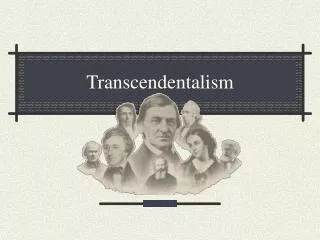
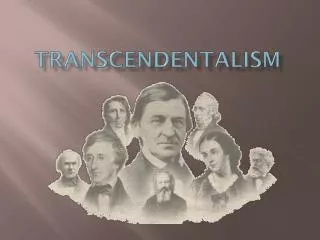
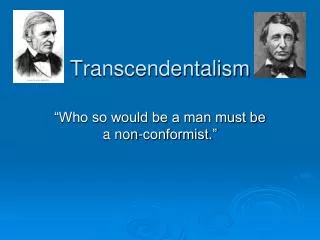
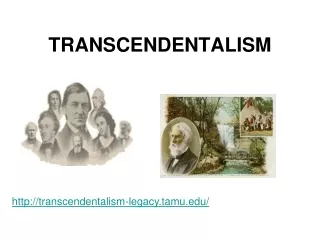
Leading writers Ralph Waldo Emerson 1803-1882 Henry David Thoreau 1817-1862 Margaret Fuller 1810-1850 Bronson Alcott Louisa Mae Alcott
What is Transcendentalism? A literary movement An intellectual movement A philosophical movement with religious undertones
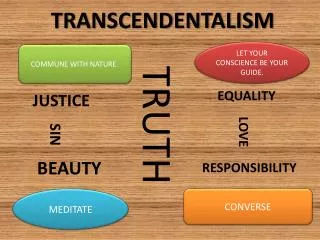
Basic Tenets of Transcendentalism Intuition is a higher faculty than understanding.
Basic Tenets of Transcendentalism The fundamental truths of being and the universe lie beyond the senses and can only be understood through intuition.
Basic Tenets of Transcendentalism Nature is a manifestation of God and the human spirit. The meaning of existence can be found through exploring nature.
Basic Tenets of Transcendentalism There is a spiritual relationship between humanity and nature.
Basic Tenets of Transcendentalism All forms of being –God, nature, man– are spiritually united under a shared universal soul—the Over-Soul.
Characteristics of Transcendentalist literature: • Romantic: it is part of the period • Focused on individualism • on democracy • on the poor and oppressed • Mystical • Optimistic • Intuitive • Philosophical
Works of the Transcendentalists “Nature” (1836) “The American Scholar” (1837) “Self Reliance” (1841) Ralph Waldo Emerson
Works of the Transcendentalists “Walden” 1854 by Henry David Thoreau “Civil Disobedience” 1849