Download

1 / 14
140 likes | 293 Vues
The Articles of Confederation marked a significant step in the evolution of American governance. Originating from the need for unity during the Revolutionary War, the First Continental Congress convened in 1774, leading to a boycott against British goods. The Second Continental Congress established a Continental Army under George Washington and drafted the Declaration of Independence in 1776. Although the Articles, created in 1777 and ratified in 1781, offered some powers to Congress, inherent weaknesses such as lack of tax authority and enforcement mechanisms prompted eventual calls for a stronger national government.

E N D
The Articles of Confederation Foundations of American Government
The First Continental Congress • Colonial Leaders first met in Philadelphia in 1774 at Independence Hall • Delegates from each colony, except Georgia, met to discuss the problems with Great Britain & encourage peaceful opposition.
The First Continental Congress This Meeting Did 3 Things: 1. It called for a boycott of all British goods. Boycott – an agreement to stop buying or using goods or services. 2. They wrote a list of grievances to King George III 3. They planned to meet again if the King did not meet their demands.
The Second Continental Congress • Decided to meet again after British soldiers clashed with colonial militias on April 19, 1775 at Lexington and Concord • Began May 10, 1775 again at Independence Hall in Philadelphia • Delegates voted to form a Continental Army led by George Washington • Most delegates were in favor of independence, but it wasn't until June 1776 that a committee of five men began drafting a declaration of independence.
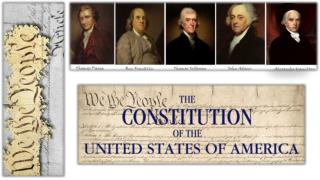
The Declaration of Independence Five men: Thomas Jefferson (VA), John Adams (MA), Benjamin Franklin (PA), Roger Sherman (CT), Robert Livingston (NY) On July 4, 1776 the delegates approved the Dec. of Independence
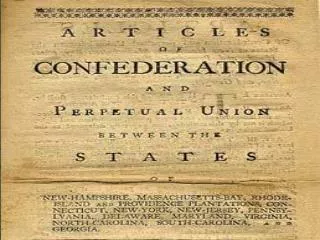
Creating a New Government • During the 5 years at war, the Continental Congress served as the new nation's government. • The Congress appointed a committee to prepare a plan of government known as the Articles of Confederation. • Congress approved the plan in 1777 and sent it to the states for ratification, approval. • The states didn't approve the Articles until 1781.
State Constitutions • State lawmakers believed that government should be based on an established set of principles. • These principles included popular sovereignty, limited government, the rule of law and majority rule. • States also separated the powers of gov. between an executive, legislative and judicial branches. • Each state constitution began with a statement of individual rights • They typically limited voting rights to white men who paid taxes and owned property
The Articles of Confederation • The Articles were written in 1777 by John Dickinson, a Pennsylvania statesman. • The Articles were accepted in Congress in 1781 and is considered the first national constitution. • Colonists feared too much power resting with one person because of experiences with monarchy • In the articles, the state governments limit the power of the national Congress.
Strengths of the Articles • Congress could declare war • Congress could negotiate with foreign countries, such as the Treaty of Paris 1783. • Congress could establish a postal system • Congress could settle disputes between states
Weaknesses of the Articles • Congress had no power to raise money through taxes • Congress had no power to regulate foreign or state trade • Laws had to be approved by 9 out of 13 states • Congress did not have the power to enforce laws • Congress could not create a uniform currency
A Reason to Rebel Farmers are required to pay their debts in gold, but they had no money because they weren’t paid during the war. Wealthy lawmakers invested their money in the war also and wanted to collect money from the farmer’s debts.
Shay’s Rebellion • Lasted 6 months 1876-77 • Poor farmers are not represented in the Massachusetts legislature and cannot pass debt relief law • The rebellion will free debtors from prisons and close courts that are hearing cases against farmers Daniel Shay
Shay’s Rebellion • The Massachusetts militia is called out to stop it • Poor farmers in 1791 elect officials who support their stance and will close courthouses and demand financial help from Congress • Shay’s rebellion will encourage national leaders to create a stronger central government