Download
1 / 12
120 likes | 250 Vues
World War I was the result of a multitude of interrelated factors including industrialization, imperial rivalries, aggressive nationalism, and militarism. As countries competed for industrial dominance, the quest for empire intensified, leading to conflicts over territories and resources. Nationalism fueled rivalry between nations, while militarism prompted an arms race and the development of advanced weaponry. Additionally, the intricate alliance system involving the Triple Entente and Triple Alliance created a geopolitical landscape ripe for conflict. Understanding these causes is essential to grasp the complexities behind the Great War.

E N D
1. Industrialization • Countries competing to be the biggest industrial strength • In order to do so, need to do what?
2. Imperial Rivalries • Industrialization lead to the desire to Imperialize • Competition over who gets what, who is most powerful
4. Militarism and Arms Race • Build up of Arms and Militaries, Just in Case • New Weapons • Creation of “Offensive Plans” - just in case Poison Gas Flame Throwers Machine Guns Grenades Tanks
4. Militarism & Arms Race Total Defense Expenditures for the Great Powers [Ger., A-H, It., Fr., Br., Rus.] in millions of £s.
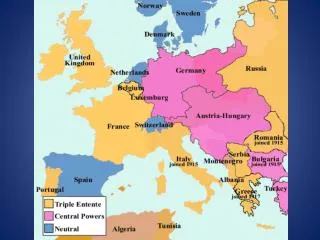
5. The Alliance System Triple Entente: Triple Alliance: Great Britain Germany France Austria--Hungary Russia Italy
5. Alliance System Allied Powers: Central Powers: Ottoman Empire Bulgaria
5. The Major Players: 1914-17 Allied Powers: Central Powers: Nicholas II [Rus] Wilhelm II [Ger] George V [Br] Victor Emmanuel II [It] Enver Pasha[Turkey] Pres. Poincare [Fr] Franz Josef [A-H]
Pan-Slavism: The Balkans, 1914 The“Powder Keg”of Europe