
Exploring Hamlet's Soliloquy: "To Be or Not to Be" and "O, What a Rogue"
In this class reading, we delve into Hamlet's profound soliloquies, particularly focusing on "To Be or Not to Be" and "O, What a Rogue." We'll engage in group work to uncover the inner arguments and antithesis within Hamlet's thoughts. Students will paraphrase these soliloquies in their own words and address questions about Hamlet's feelings of isolation, self-perception as a "rogue," and his comparisons with actors. Through examining the theatrical language, we aim to understand Hamlet's complex character and motives. **Relevant

Exploring Hamlet's Soliloquy: "To Be or Not to Be" and "O, What a Rogue"
E N D
Presentation Transcript
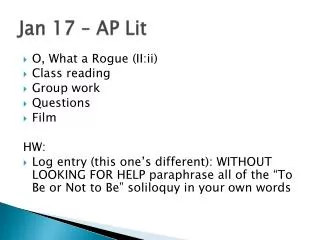
Jan 17 – AP Lit • O, What a Rogue (II:ii) • Class reading • Group work • Questions • Film HW: • Log entry (this one’s different): WITHOUT LOOKING FOR HELP paraphrase all of the “To Be or Not to Be” soliloquy in your own words
Soliloquies • Hamlet’s major soliloquies are debates, arguments, discussions and/or discoveries “between self” • When you read them, you should look for: • Inner argument • Antithesis (the balancing of two contrasting ideas, words, phrases or sentences in parallel grammatical form)
O, What a Rogue • Turn to Act II, Scene ii, lines 529-end • Read the soliloquy as a class (in round) • Paraphrase • Answer questions: • It’s obvious that Hamlet is standing alone. Why, then, does he begin with “Now I am alone”? • Why does he refer to himself as a “rogue” and a “peasant slave”? • Hamlet compares himself to the player. What does this show us about his self-perception? • Hamlet uses a lot of theatrical terminology in the play. Why might he be thinking in theatrical terms? • Find examples of why Hamlet might think himself a coward. Do you agree that he is a coward, or is there another reason for his behavior?