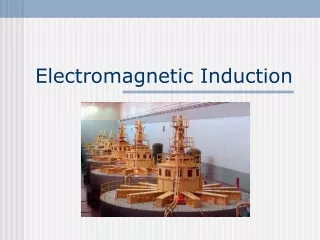
Electromagnetic Induction
This presentation by Wong Chun Jie, Leong Qi Dong, and Jwa Li Wen explores electromagnetic induction concepts. It illustrates how a magnetic field can create an electromotive force (emf) in a conductor. Through a detailed examination of Faraday’s solenoid experiment, we analyze the relationship between moving magnets and induced currents. Results show deflection in galvanometer readings when magnets are in motion, aligning with Lenz’s law. This summarizes key findings and laws such as Faraday’s Law of Induction, reinforcing the principles of conservation of energy.

Electromagnetic Induction
E N D
Presentation Transcript
Electromagnetic Induction Group: Induction Wong Chun Jie Leong Qi Dong Jwa Li Wen 4S2 2012 T3
Introduction • Current flowing through a conductor produces a magnetic field • Can a magnetic field produce a current in a conductor?
Video • http://www.youtube.com/watch?v=ITuR3AQAYI8 • 1:07:50 – 1:10:4`
Theory – Electromotive Force (emf) A varying magnetic flux produced an e.m.f, which produces an induced current in a closed circuit.
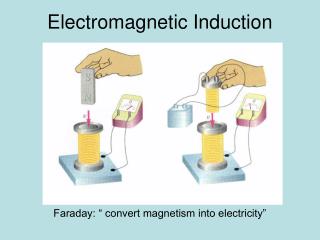
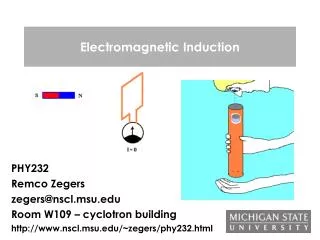
Steps 1. Move magnet into solenoid 2. Leave the magnet in solenoid 3. Move magnet out of solenoid
Variables Dependent: (1) Deflection of galvanometer pointer (2) Direction of deflection (3) Magnitude of deflection Independent: • Pole of magnet • Number of turns in solenoid • Strength of magnet • Cross-sectional area of solenoid • Speed of magnet being moved in and out
Results (1) Deflection of galvanometer pointer • Deflects: magnet is moving in and out of solenoid • Does not deflect: magnet remains stationary in solenoid • Current is flowing through circuit only when the magnet is moving in and out of the solenoid
Conclusion • A varying magnetic field produces an e.m.f, which produces an induced current in a closed circuit.
Results (2) Direction of deflection
Conclusion Lenz’s Law • The direction of the induced emf, and thus, the induced current in a closed circuit, is always such that the magnetic effect always opposes the change producing it. • Why oppose? • In Work, Energy, Power: GPE = KE • In Electromagnetic Induction: GPE = KE + Electrical energy • KE decreases for the conservation of energy
Results (3) Magnitude of deflection Increase in • number of turns in solenoid • strength of magnet • cross-sectional area of solenoid • speed of magnet being moved in and out Increases deflection – increases emf N ΦB Rate
Conclusion • Faraday’s Law of Induction • Where ℰ is the emf • Induced emf generated in a conductor is proportional to the rate of change of magnetic flux vectorlinking the circuit.
References • http://physics.tutorvista.com/electricity-and-magnetism.html#close_iframe • http://en.wikipedia.org/wiki/Faraday's_law_of_induction • http://en.wikipedia.org/wiki/Magnetic_flux • http://en.wikipedia.org/wiki/Electromotive_force