Magnus Marklund, PhD student ETC
120 likes | 251 Vues
This project focuses on the development of an advanced process model for a downflow entrained-flow reactor utilized in pressurized black liquor gasification. The model, created using a commercial CFD code, incorporates components like a simplified atomizer/burner, submodels for drying, pyrolysis, char gasification, and turbulence modeling. It aims to enhance design optimization across varying unit sizes. The methodology includes discrete droplet analysis and advanced heat transfer models. Potential collaborations and future developments are considered in pursuit of refining gasification processes.


Magnus Marklund, PhD student ETC
E N D
Presentation Transcript
Modelling, Simulation and Optimisationof a Downflow Entrained-flow Reactorfor Pressurised Black Liquor Gasification Magnus Marklund, PhD student ETC
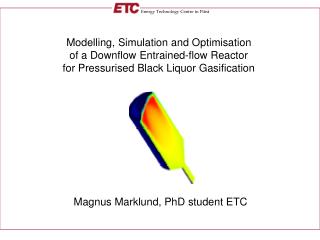
Gasification Plant Gasification Reactor 600 mm H: 1886 mm
Objective The main goal is to develop an advanced process model forthe reactor that can be used for design optimisation ofarbitrary unit sizes.
Main model specifics • Based on a commercial CFD code • Simplified atomiser/burner • Submodels for drying, pyrolysis, and char gasification • Gas/droplet interactive turbulence model • Partial combustion of fuel gases • Inclusion of radiation and conjugate heat transfer • Submodel for thickness prediction of smelt layer on wall • Inorganic (smelt) reactions
Methodology • CFX4 (or FLUENT 6/CFX5) • Distribution of non interacting discrete droplets • Droplet conversion by customised user routines • k-e and Reynolds stress turbulence models • Gas combustion modelled by EDC • Discrete transfer or Monte Carlo method for thermal radiation and a coupled model for conjugate heat transfer • Åbo Academy’s model for wall layer thickness • Inorganic (smelt) reactions by customised user routines
Plan 01/02 • CFD4: Possible collaboration with Dr. Fletcher USYD or Åbo Academy • EXP1: Possible founding of a Particle Dynamics Analysis (PDA) device
Modified coal combustion model Needed: • Proximate analysis (Moisture, volatiles, fixed carbon, and ash) • Ultimate analysis of the volatiles and fixed carbon • Higher heating value • Emissivities for droplet and char particle Devolatilization: • Moisture and volatiles are released at a rate proportional (Arrhenius) to the remaining volatiles in the droplets • Droplet swells linearly with released volatiles Char gasification: • Only combustion with oxygen • Controlled by diffusion of oxygen to the droplet surface and the char reactivity
Uncertainties and difficulties Uncertainties: • Droplet size and velocity distributions from burner • Parameters for devolatilization and gasification rates • Characteristic volatile composition • Gasification of char • Boundary conditions for heat transfer Difficulties: • Resolving the burner • Convergence
Simulations So far... • 2-dimensional axi-symmetric model • Burner modelled as a circular inlet • Simplified mechanistic model (no gas/ droplet interaction) • CFX4 coal combustion model • K-e turbulence model • Eddy Dissipation Model (EDM) and Eddy Dissipation Concept (EDC) …to come • 2D and 3D models • More detailed burner (separate inlets for liquor and oxygen) • Implementation of a more advanced droplet/gas interaction model • Reynolds stress turbulence model • Wall smelt layer
First results (simple model) 90º Full-cone 95º Full-cone
Latest results (coal model) 70° full cone spray 110° full cone spray
For updated information www.etcpitea.se/blg Acknowledged sponsors: