Chemical Kinetics
Chemical kinetics examines the rates at which reactions occur and the factors influencing them. Key aspects include the physical state and concentration of reactants, temperature, and the presence of catalysts. This chapter introduces foundational concepts, including how to express reaction rates mathematically and the importance of reaction stoichiometry. Understanding reaction orders and rate laws experimentally helps predict how changes in conditions affect the speed of reactions. It explores the relationships between reactant concentrations and reaction rates to establish comprehensive insights into reaction dynamics.

Chemical Kinetics
E N D
Presentation Transcript
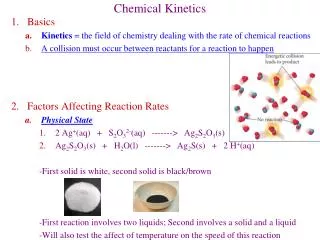
Chemical Kinetics Chapter 14
Chemical Kinetics Thermodynamics – does a reaction take place? Kinetics – how fast does a reaction proceed?
Factors That Affect Reaction Rates • Physical State of the Reactants • Concentration of Reactants • Temperature • Presence of a Catalyst Fig 14.2
A B rate = D[A] D[B] rate = − Dt Dt Reaction rate - the change in the concentration of a reactant or a product with time (M/s) D[A] = change in concentration of A over time period Dt Because [A] decreases with time, D[A] is negative D[B] = change in concentration of B over time period Dt
rate = D[A] D[B] rate = − Dt Dt Fig 14.3 Progress of a hypothetical reaction A→B
Change of Rate with Time C4H9Cl (aq) + H2O (l)→ C4H9OH (aq) + HCl (aq) • Average rate decreases as reaction proceeds • As the reaction goes forward, there are fewer collisions between reactant molecules
d[CH4] rate = − dt Fig 14.4 Concentration of butylchloride as a function of time Initial rate ≡ rate at t = 0 • Instantaneous rate ≡ slope of line tangent to the curve at any point
−[C4H9Cl] t Rate = = [C4H9OH] t Reaction Rates and Stoichiometry C4H9Cl (aq) + H2O (l)→ C4H9OH (aq) + HCl (aq) • In this reaction, the ratio of C4H9Cl to C4H9OH is 1:1 • Rate of consumption of C4H9Cl = rate of formation of C4H9OH
1 2 [HI] t Rate = − = [I2] t Reaction Rates and Stoichiometry • What if the ratio is not 1:1? 2 HI (g) → H2 (g) • In such a case:
aA + bB cC + dD = = rate = − = − Δ[C] Δ[B] Δ[D] Δ[A] 1 1 1 1 Δt Δt Δt Δt c b a d Reaction Rates and Stoichiometry Eqn [14.4]
Br2(aq) + HCOOH (aq) 2Br −(aq) + 2H+(aq) + CO2(g) time Fig 14.5 Basic components of a spectrophotometer Br2(aq) Br −(aq)
Br2(aq) + HCOOH (aq) 2Br −(aq) + 2H+(aq) + CO2(g) time Br2(aq) 393 nm Br2(aq) Br −(aq) Beer’s Law: A = abc D[Br2] D Absorption
aA + bB cC + dD The Rate Law Rate law - expresses the relationship of the rate of a reaction to the rate constant and the concentrations of the reactantsraised to some powers Rate = k [A]x[B]y reaction is xth order in A reaction is yth order in B reaction is (x +y)th order overall
F2(g) + 2ClO2(g) 2FClO2(g) 1 Rate Laws • Rate laws always determined experimentally • Reaction order always defined in terms of reactant (not product) concentrations • Order of a reactant is not related to the stoichiometric coefficient of the reactant in the balanced chemical equation rate = k [F2][ClO2]
Br2(aq) + HCOOH (aq) 2Br −(aq) + 2H+(aq) + CO2(g) rate k = [Br2] Plot of rate vs [Br2] rate [Br2] rate = k [Br2] y = mx + b = rate constant = 3.50 x 10⁻³ s-1