Understanding Chemical Reactions: Balancing Equations Made Easy
110 likes | 269 Vues
This guide provides a comprehensive overview of chemical reactions, focusing on how to write and balance chemical equations. It explains the key components, including reactants, products, and yields, and illustrates their representations through word equations, skeleton equations, and balanced equations. By using examples such as magnesium oxide reacting with carbon to produce carbon monoxide, this guide will help you grasp the concept of balancing equations step-by-step. Perfect for students and enthusiasts alike!


Understanding Chemical Reactions: Balancing Equations Made Easy
E N D
Presentation Transcript
A Chemical Reaction Reactants Products Yields (produces)
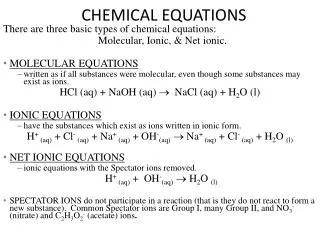
Writing a Chemical Equation Chemical symbols give a “before-and-after” picture of a chemical reaction ReactantsProducts MgO + C CO + Mg magnesium oxide to yieldcarbon monoxide reacts with carbon and magnesium
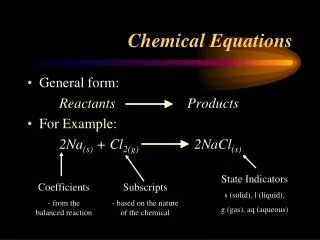
Ways to represent a chemical reaction: • Word Equation hydrogen + oxygen water • Skeleton Equation H2 + O2 H2O • Balanced Equation 2H2 + O2 2H2O
Balancing Equations • Write the skeleton equation Make sure compound adds to zero using subscripts Mg + O2 MgO 2. Start counting on the left and balance using coefficients ___ Mg + ___ O2 ___ MgO 3. At arrow repeat until done You can make odd numbers even ( X 2) +2 -2 2 2
Steps in Balancing An Equation Fe3O4 + H2 Fe +H2O Fe:Fe3O4 + H23 Fe +H2O O:Fe3O4 + H2 3 Fe +4H2O H: Fe3O4 + 4 H2 3 Fe +4H2O
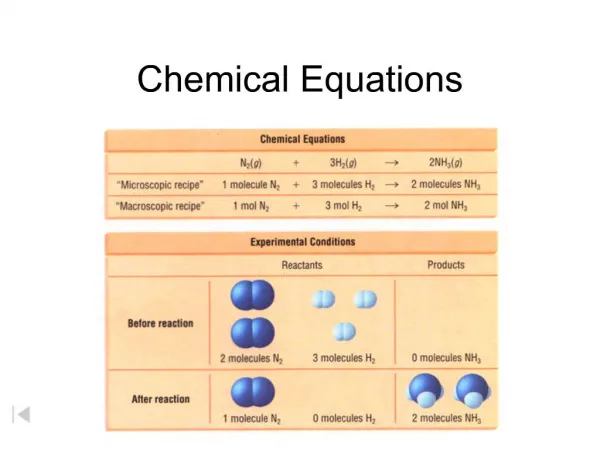
What does it mean? 4 Al(s) + 3 O2(g) ---> 2 Al2O3(s) This equation means 4 Al atoms + 3 O2 molecules ---produces---> 2 molecules of Al2O3 AND/OR 4 moles of Al + 3 moles of O2 ---produces---> 2 moles of Al2O3
Balancing Equations ___ Al(s) + ___ Br2(l) ---> ___ Al2Br6(s) 2 3
Learning Check: Fe3O4 + 4 H2 3 Fe +4H2O A. Number of H atoms in 4 H2O 1) 2 2) 4 3) 8 B. Number of O atoms in 4 H2O 1) 2 2) 4 3) 8 C. Number of Fe atoms in Fe3O4 1) 1 2) 3 3) 4
Practice • __N2 + __H2 __NH3 • __NH3+ __O2 __HNO3 + __H2O • __H2+ __Fe2O3 __Fe+ __H2O • __C2H4+ __O2 __CO2+ __H2O 3 2 2 3 2 3 3 2 2
Harder Practice! • __Na + __H2O __NaOH + __H2 • __NH3+ __O2 __NO+ __H2O • Copper (II) sulfide + nitric acid copper (II) sulfate + nitrogen dioxide + water __CuS+ __HNO3 __CuSO4+ __NO2 + __H2O 2 2 2 4 5 4 6 8 8 4