Exploring Primary Sources for Understanding U.S. History and Foreign Policy
This resource provides an overview of primary source types, including documents, video, audio, and images, useful for analyzing significant historical events like the Roosevelt Corollary to the Monroe Doctrine. It guides educators on effectively locating primary sources using search engines and specialized links. The project ideas encourage participation in National History Day and suggest creating repositories of primary sources through student research. Citing sources and building bibliographies is streamlined with recommended online tools, fostering a comprehensive understanding of U.S. history.

Exploring Primary Sources for Understanding U.S. History and Foreign Policy
E N D
Presentation Transcript
Primary Source Research ICE 2006 Chris Osborne Independent Consultant rcosborne@insightbb.com http://rcosborne.home.insightbb.com
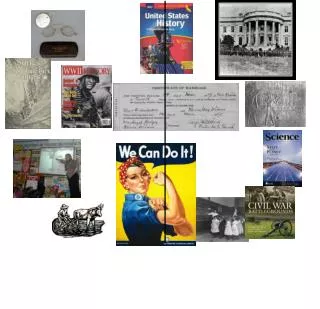
Types of Primary Sources • Documents • http://www.ourdocuments.gov/ • Video/Audio • http://www.historychannel.com/broadband/home/ • Images/Maps • http://www.indianahistory.org/library/digital_image/digitalpics.html
Addressing Indiana Standards • 3.6 Analyze “The Roosevelt Corollary to the Monroe Doctrine” (1904). Explain how it modified the Monroe Doctrine (1823) and justified a new direction in United States foreign policy. (Civics and Government) • http://www.pinzler.com/ushistory/corollarysupp.html • http://www.u-s-history.com/pages/h1449.html • http://www.latinamericanstudies.org/us-relations/roosevelt-corollary.htm
How do I effectively find these sites? • Start at Google • http://www.google.com/ • In your search criteria, use +, -, “quotes” etc. • Example: “roosevelt corollary” +primary +sources
Project Ideas • National History Day in Indiana • http://www.indianahistory.org/historyday/index.html • This is a project that is not just for social studies or US History. A great opportunity to team, it addresses multiple standards, is ready made for easy participation, and allows students a variety of project types to pursue for multiple intelligences. • Develop your own repository of primary sources by utilizing student research collections. The students can build a “library” through interviews, photos, etc. • Time Capsule Projects
Citing Sources • http://notestar.4teachers.org/ • This site allows teachers to create classes, project, group, etc. • Students can keep track of online/offline sources and print out bibliographies in MLA or APA format. • http://www.easybib.com/ • This is not as in-depth as Notestar, but is useful in helping students create bibliographies.
Extra Links – Enjoy These examples • http://womhist.binghamton.edu/ • -Women and social movements in the U.S. • http://www.ellisisland.org/ • -Digitized records of immigrants entering U.S. • http://www.rootsweb.com/~canmil/ww1/letters/ • -Canadian military letters home • http://www.nps.gov/gett/gettkidz/letters.htm • -Gettysburg Kidzpage with civil war soldier’s letters • http://www.lib.byu.edu/~rdh/wwi/ • -World War I document archive • http://web.jjay.cuny.edu/~jobrien/reference/ob60.html • -The Nazi decrees of 1933 • http://www.uidaho.edu/special-collections/Other.Repositories.html • -Repositories of Primary Sources
Thank You for Attending • Contact Me – Chris Osborne • 317-882-6681 • rcosborne@insightbb.com • http://www.ezwebsite.org/chris • http://rcosborne.home.insightbb.com/