Recent Advances in QCD at HERA: Insights from Polarized Lepton Interactions
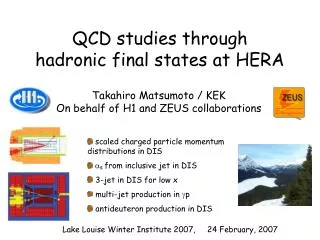
This presentation by Takahiro Matsumoto from KEK highlights recent findings in Quantum Chromodynamics (QCD) from the HERA accelerator, which operated from 1992 to 2007. Key topics include the use of longitudinally polarized leptons for electroweak tests, measurements of proton structure functions, and studies of hadronic final states. Data collected during HERA-I/II has facilitated significant improvements in understanding parton distribution functions and fragmentation functions, contributing critical insights into particle physics.

Recent Advances in QCD at HERA: Insights from Polarized Lepton Interactions
E N D
Presentation Transcript
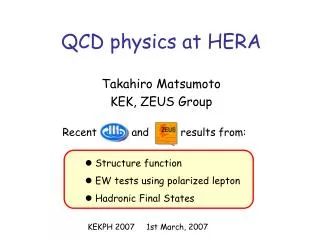
QCD physics at HERA Recent and results from: Takahiro Matsumoto KEK, ZEUS Group • Structure function • EW tests using polarized lepton • Hadronic Final States KEKPH 2007 1st March, 2007
HERA accelerator DESY, Hamburg Ring ~ 6.3 km • HERA; start 1992… end June 30, 2007 • Only one ep collider in the world Proton e p 27.6 GeV 920 GeV √s = 318 GeV Electron or positron Takahiro Matsumoto
Longitudinal polarized lepton • Self polarization of electrons by Synchrotron radiation (Sokolov-Ternov effect) • Use spin rotator for longitudinal polarization • Applied to H1 and ZEUS from 2002- • Polarization: • 30-40% (both for L&R) • Useful for EW tests in DIS Takahiro Matsumoto
The Detectors Multi-purpose detectors with Calorimeter, Tracking system Uranium-Scintillator calorimeter Liquid-Argon calorimeter s(E)/E = 35%for hadrons s(E)/E = 50%for hadrons s(E)/E = 18%for electrons s(E)/E = 12%for electrons Both detectors provide competitive measurements on QCD Takahiro Matsumoto
Luminosity (HERA-I/II) as of Feb. 20, 2007 • HERA-I (1992~2000) • e+p 110 pb-1 • e-p 15 pb-1 (on tape) • Unpolarized lepton Matured analyses, being finalized • HERA-II (2002~2007) • e+p 130 pb-1 • e-p 250 pb-1(on tape) • Longitudinally polarized lepton • Si vertex detector for b,c tagging New results with larger statistics, new capabilities are being produced 06/07 04-06 92-00 02/03 ~70% is recorded on the tape Takahiro Matsumoto
Deep Inelastic Scattering at HERA • HERA; Giant electron micro scope of the proton • Q2 up to 4 Ee Ep ~ 105 GeV2 Space resolution; 0.001 fm Proton structure can be measured for wide kinematic range • Various QCD studies using Hadronic final states 920 GeV 27.6 GeV Takahiro Matsumoto
DIS (cont’d) Related to Q2 = - (k-k’)2 x = Q2/2P•(k-k’) x P Parton Distribution Function Main source Neutral Current DIS: ~ S x (qf – qf) Small for Q2 < < MZ2 Y± = 1 ±(1-y)2, inelasticity y = Q2/xs Longitudinal component Small, 0 for LO QCD dumped with y2 F2, F3, FL Structure function of the proton Takahiro Matsumoto
Kinematic regions • HERA covers wide span (~O(106) ) for Q2 and x region, compared to Fixed targets and Tevatron • Structure function: • Evolution in Q2, measured very well • Low x region is only covered by HERA Important input for LHC ! LHC x region Takahiro Matsumoto
Structure function, F2 • Sea quark is dynamically produced for high Q2 in low x Scaling violation F2 • Predicted by DGLAP (Dokschitzer-Gribov-Lipatov-Altarelli-Parisi) evolution equation for wide kinematic region Triumph of perturbative QCD Takahiro Matsumoto
High Q2 DIS • Low Q2 • NC, mediated by g • CC, suppressed by W mass • High Q2( >> MZ2, MW2 ) • NC and CC cross sections compatible Electroweak unification ! Neutral Current For NC, Q2 >~ MZ2 is also interesting to see effect of g/Z interference Charged Current MZ2 Takahiro Matsumoto
F2, xF3 at High Q2 Y± = 1± (1-y)2 E polarization F2 = S Af x (qf + qf) = F2g- (ve + Pe ae) cZ F2gZ + O(cZ2) xF3 = S Bf x (qf- qf) = - (ae + Peve)cZ xF3gZ + O(cZ2) g(EM) gZ (EW cZ order) Z (EW cZ2 order) visible @High Q2 EW coupling vf = T3f – 2ef sin2qW, af = T3f F2gZ = S 2 efvf x ( qf + qf ) ve ~ 0 ( because 2sin2qW ~ ½) xF3gZ=S2 efaf x ( qf – qf ) Unpol data seen in xF3 (s(e-p) – s(e+p)) af of quarks EW effect? pol data also in F2 af, vf of quarks Takahiro Matsumoto
xF3 (unpol) • xF3 at High Q2 is useful to determine valence quark PDF • complementary to neutrino DIS at Low Q2 xF3 ~ S x (qf – qf), obtained from s(e-p) – s(e+p) Takahiro Matsumoto
Polarization asymmetry at High Q2 PR > 0 PL < 0 e+p A+ A- e-p First observation of parity violation in e±p NC DIS Takahiro Matsumoto
Light quark EW coupling • ZEUS fit to HERA-I e±p DIS, jets + HERA-II pol e-p DIS • Consistent with SM • Better precision than H1 unpol results (especially for vu,d) • Better precision than Tevatron, LEP Takahiro Matsumoto
Obtained PDF HERA-I +HERA-II • Inclusion of HERA-II data with polarization • Consistent results with HERA-I • Smaller uncertainties of PDF at High Q2 + HERA-II HERA-I Good News for LHC Takahiro Matsumoto
Hadronic final states @HERA Jet production at HERA This talk covers recent results on: - fragmentation function - hard process QCD (as, low x) - other topics (multi-parton interaction, antideuteron) as as Cross section for HFS: Fragmentation function Parton distribution function of the proton Cross section of the hard process Regarded as hadronic correction ~ 1 + dhad in jet studies Takahiro Matsumoto
Breit frame parton from proton (for the interaction) is back scattered with the same momenta Advantages in Breit frame: • Current region can be compared to e+e- experiments • Current quark and proton remnants are clearly separated Target region Current region [Proton remnants] Takahiro Matsumoto
Scaled charged particle momentum distributions in DIS L = 44 pb-1 (2000) • For tracks in current region of Breit frame, define: • xp = p/(Q/2) • Measurements of dn/dxp for Q <~100 GeV and full xp range H1prelim-05-133 Scaling violation is clearly observed 1/N dn/dxp Q increasing xp Agreement with e+e- experiments, and RAPGAP(PS) MC tuned to e+e- universality of quark fragmentation function Takahiro Matsumoto
Jet analysis Breit frame • theoretically favored, no overlapping • No gluon No PT components • Contributions from QCD radiation can be seen in high ET jet Longitudinally invariant kT algorithm Radius parameter [usually set to 1] For each Energy Flow Object, calculate dii, dij under Breit frame dii = ET,i2 R2 Order all dii and dij If dii is minimum i is regarded as jet dij = min[ET,i2,ET,j2][Dh2 + Df2] If dij is minimum i and j are merged, further iteration Takahiro Matsumoto
Inclusive jet in DIS NLO describes inclusive jets well Agreement also for smaller radius (R=0.7,0.5) Interesting for studying jets from heavy particles asextraction for as Small uncertainty of as (main concern is theoretical part) is obtained from Q2>500GeV2 and R=1 Takahiro Matsumoto
as running is clearly seen ZEUS (DESY-06-241) H1prelim-05-133 Consistent with PDG’2006: as(MZ) = 0.1176 ±0.002 Takahiro Matsumoto
as measurements at HERA as running many as from jets and scaling violation in the structure function All give consistent results Takahiro Matsumoto
Low x QCD • We want to estimate LHC PDF from Tevatron and HERA data • DGLAP QCD evolution sufficiently works? • Need to care low x • Saturation? • Breakdown of DGLAP? Study at HERA LHC Tevatron HERA Takahiro Matsumoto
Evolution, Resummation • DGLAP (Dokshitzer-Gribov-Lipatov-Altarelli-Parisi) • kT ordering, describe evolution in Q2, but fails at low x • BFKL (Balitsky-Fadir-Kuraev-Lipatov) • No kT ordering, applicable to low x • CCFM (Ciafaloni-Catani-Fiorani-Marchesini) • angular ordering, describe evolution both in Q2 and x ( applicable to low x @ BFKL and High Q2 @ DGLAP) ~(lnQ2)n Gluon ladder diagram ~(ln(1/x))n BFKL: expect more energetic jets in forward Takahiro Matsumoto
Extended to forward rapidity 2 < hjet < 3.5 • 0.0004 < xBj < 0.005 Forward jet L = 82pb-1 • LEPTO (DGLAP) • Disagree with data • CASCADE (CCFM) • Set 2 ( with no singular term ) is better • OK for Q2 and ET • But fail in xBj and h • ARIADNE • Color dipole model • unordered kT, but not BFKL… • Good agreement Comparison with LO+PS MC Takahiro Matsumoto
Forward jet (cont’d) Comparison with NLO QCD calculation with hadronization correction • NLO, improved from LO calculation (k=s(NLO)/s(LO)~10) • Data is larger than NLO prediction, but within large theoretical uncertainty * except lowest xBj * DISENT: Fixed order QCD partonic cross section, on mass shell ME + DGLAP Takahiro Matsumoto
3-jet in DIS for low x qjet < 20º • Low x DIS • DGLAP (kT ordering) may be insufficient to describe g radiation • 3-jet in DIS • Low Q2: 5 < Q2 < 80 GeV2 • Low x: 10-4 < x < 10-2 • 2 jets in forward • Sensitive to g radiation • Fixed order QCD prediction, O(as3) is greatly improved from O(as2) , but still discrepancy exists at small x need NNLO or unordered gluon radiation? xjet = Ejet*/Ep,beam > 0.035 L= 44pb-1 ~ as3 (usually 3-jet: ~as2) Takahiro Matsumoto
Four jets in photoproduction Q2 < 1 GeV2 • Test of pQCD in higer orders of as • Can adjust multi-parton interaction model to agree with data related to LHC (underlying event) g quasi-photon 4jet direct (tree level) Multi-jet at HERA O(aas3) Schematic view of MPI Takahiro Matsumoto
ZEUS (prel.) 121 pb-1 MC without MPI underestimates the data in low Mnj region First observation of 4 jets in photoproduction HERWIG with tuned MPI describes the data well Fraction of the photon’s momentum exchanged in the interaction Takahiro Matsumoto
Antideuteron production in DIS Q2 > 1 GeV2 • Antideuteron production: • Studied in nuclear experiments (PHENIX etc.), but not well known for elementary particle collisions • Search in DIS first time • Mass was calculated from dE/dx, p • Also use DCA to beam spot, Zvtx • First observation of antideuteron in DIS • N(d) = 61 ±8 ZEUS (prel.) 120 pb-1 dE/dx(mips)>2.5 Takahiro Matsumoto
d/p, p/p ratios in DIS Q2 > 1 GeV2 • Ratios were measured after correction of efficiency for tracking and dE/dx cut • d/p ~ 5 x 10⁻⁴ • Consistent with U(1S)(ARGUS), pp • But d production is suppressed in e+e- qq • p/p ~ 1 • Asymmetry is not observed 0.3 < pT/M < 0.7, |y|< 0.4 Takahiro Matsumoto
Coalescence model Consistent with pp, pA HERA • Process dependent • Pp ~ pA ~ gp • Suppressed in e+e- and also in AA B2 ~ 1 / V (freeze out volume) Suppression in AA larger source size Recent measurements in e+e-also show the suppression (mechanism, not well known yet…) Takahiro Matsumoto
Summary • Structure function in wide Q2 and x range • F2; Steep rise in F2 at low x (sea quark and gluon), well described by pQCD (DGLAP) • xF3; gZ interference at High Q2, sensitive to valence quark • Light quark EW coupling; benefit from polarized lepton • Proton PDF determination • Hadronic final states • Various QCD studies; fragmentation, as, low x, multiple parton interaction, coalescence • Many other interesting items were missed this time • Diffraction, heavy flavor, new physics search etc. • HERA, operating 15 years and end up with this year. Inclusion of HERA-II results with polarized lepton, finally will improve our knowledge on QCD Takahiro Matsumoto