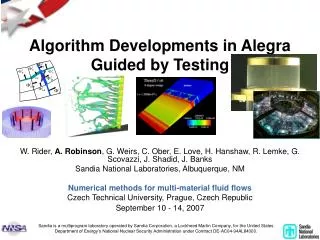
Numerical Algorithm Development and Testing in HYCOM
This project focuses on validating HYCOM through standardized tests and improving basic algorithms. Evaluation includes various advection schemes like MPDATA, CS-FCT, UTOPIA, WENO for applications like gravitational adjustment, density anomalies, and advection errors. Additionally, the study delves into numerical cabbeling and discontinuous Galerkin methods for enhanced computational accuracy.

Numerical Algorithm Development and Testing in HYCOM
E N D
Presentation Transcript
Process Oriented Test Problems • Model validation against known solutions • Test/improve basic algorithms • Standardized tests Gravitational Adjustment (advection) Seamount (Pressure Gradient Errors) Overflows (mixing)
Advection Schemes • Evaluation of several advections schemes (MPDATA, CS-FCT, UTOPIA, WENO) • Applications/Tests: Gravitational Adjustment Density Anomalies due to T/S advection
HYCOM Vertical Coordinates MICOM mode Viscosity=100 Hybrid mode
HYCOM with z-levels viscosity=100 WENO5-RK2 Viscosity=0
SEOM 100 SCRUM 100 SEOM 50 SCRUM 50
Advection Schemes • Centered Difference • MPDATA • UTOPIA • WENO
Centered Differences • High order centered interpolation to cell edges • Leap-Frog Trapezoidal time stepping • O(Dt^2, Dx^(2n) ) • No dissipation errors due to spatial discretization • Gibbs oscillation controlled with FCT
MPDATA • Based on Donor Cell scheme • TE Estimate corrects dissipative DC • Positivity preserving • Non-oscillatory option a la FCT • 2nd order in time/space, 3rd order option • Not dependent on positive offset anymore
UTOPIA • Uniform third order polynomial interpolation algorithm • Upwind biased interpolation • 3rd order in space/time for constant advection, otherwise only 2nd order. • multidimensional • Universal Limiter option • Large stencil
WENO • Weighed Essentially Non-Oscillatory • Adjust stencil based on smoothness • ENO criterion: Newton divided differences • WENO uses a combination of these estimates to extend the order in smooth regions to O(2k-1) • Expensive
WENO • Weights depends on smoothness of solution • TVD RK scheme for time integration • High order extended right up to discontinuity • Smooth extrema are preserved • CPU intensive • Large stencil
Numerical Cabbeling • Numerical mixing may lead to cabbeling • r = r(T,S) • How do these schemes preserve correlations?
Spatial Discretization • Complex Coastlines • Improve Geometry Representation • Variable Resolution Grids (coupled coastal-basin scale simulations)
Discontinuous Galerkin Method • FEM type method • Solution discontinuous at element edges • Local element-wise Computations • Local conservation • Flux-based exchange at element edges • Simple interpolation order adaptation • Couple to Current Hycom
Issues • Robust advection scheme to handle layer outcropping and interaction with topography • Experimental shallow water high-order FV model • Extension to DGM and multilayers.