Understanding Vectors and Scalars: A Comprehensive Introduction
This introduction explores the fundamental concepts of vectors and scalars in physics. Vectors are quantities that possess both magnitude and direction, such as displacement and velocity, while scalars only have magnitude, such as mass and time. The document covers the notation and graphical representation of vectors, how to measure their magnitude, and the principles of vector addition, including both graphical and component methods. It also discusses equal and inverse vectors, providing a clear understanding of these essential physical concepts.

Understanding Vectors and Scalars: A Comprehensive Introduction
E N D
Presentation Transcript
Vectors An Introduction
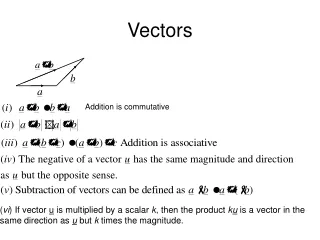
There are two kinds of quantities… • Vectors are quantities that have both magnitude and direction (e.g., displacement, velocity, acceleration). • Scalars are quantities that have magnitude only (e.g., position, speed, time, mass).
→ • Vector:R R R head tail Notating vectors This is how you draw a vector.
Notating scalars • Scalar:R There is no standard way to draw a scalar!
θ x θ x B A Direction of Vectors
y II 90o < θ < 180o I 0 < θ < 90o x θ θ θ θ III 180o < θ < 270o IV 270o < θ < 360o Vector angle ranges
Magnitude of Vectors • The best way to describe the magnitude of a vector is to measure the length of the vector. • The length of the vector is proportional to the magnitude of the quantity it represents.
If vector A represents a displacement of three miles to the north… A B Then vector B, which is twice as long, would represent a displacement of six miles to the north! Magnitude of Vectors
Equal Vectors Equal vectors have the same length and direction, and represent the same quantity (such as force or velocity).
A -A Inverse Vectors Inverse vectors have the same length, but opposite direction.
A θ x Ax Vectors: x-component Ax = A cos θ
A θ Ay x Vectors: y-component Ay = A sin θ
Vectors: angle θ = tan-1 (Ry/Rx) y Ry θ x Rx
R = √ (Rx2 + Ry2) Vectors: magnitude y R Ry x Rx
Graphical Addition of Vectors • You’ll need: Graph paper Pencils Ruler Protractor
B A R Graphical Addition of Vectors A + B = R R is called the resultant vector!
The Resultant and the Equilibrant The sum of two or more vectors is called the resultant vector. The resultant vector can replace the vectors from which it is derived. The resultant is completely canceled out by adding it to its inverse, which is called the equilibrant.
B E A R Graphical Addition of Vectors A + B = R E is called the equilibrant vector!
Component Addition of Vectors • Resolve each vector into its x- and y-components. Ax = Acosθ Ay = Asinθ Bx = Bcosθ By = Bsinθ Cx = Ccosθ Cy = Csinθ etc. • Add the x-components (Ax, Bx, etc.) together to get Rx and the y-components (Ay, By, etc.) to get Ry.
Component Addition of Vectors • Calculate the magnitude of the resultant with the Pythagorean Theorem R = √(Rx2 + Ry2) • Determine the angle with the equation θ = tan-1 Ry/Rx.
Vs Vw Vt = Vs +Vw Relative Motion S = swimmer W = water
Vs Vw Vt = Vs +Vw Relative Motion
Vs Vw Vt = Vs +Vw Relative Motion