Upcoming Topics and Schedule in Chemistry: Midterms, Orbital Theory, and Final Exam Review
280 likes | 416 Vues
Stay on top of your chemistry studies with this exciting schedule covering key topics in the coming weeks. From the atmosphere and light theories to the intricacies of quantum mechanics, bonding models, and VSEPR theory, this course will enhance your understanding. Prepare for the midterm and cumulative final exam, which comprises significant portions of your total grade. Important equations and model explanations will be discussed, helping you navigate through complex concepts effectively. Don’t miss office hours for personalized assistance!


Upcoming Topics and Schedule in Chemistry: Midterms, Orbital Theory, and Final Exam Review
E N D
Presentation Transcript
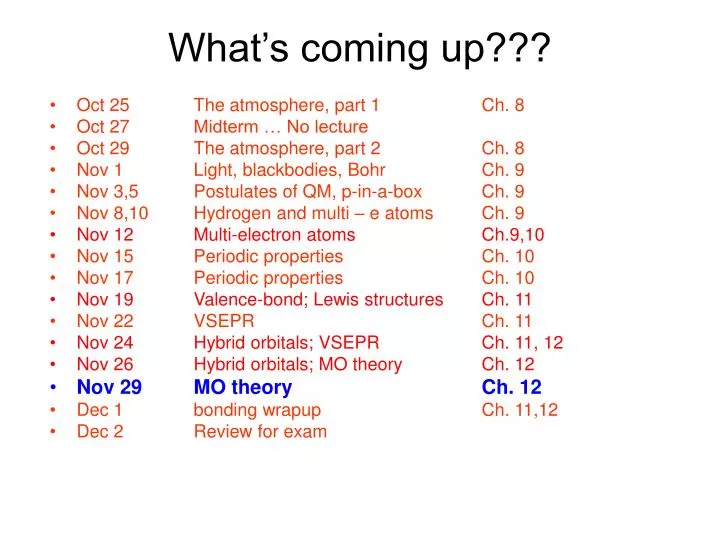
What’s coming up??? • Oct 25 The atmosphere, part 1 Ch. 8 • Oct 27 Midterm … No lecture • Oct 29 The atmosphere, part 2 Ch. 8 • Nov 1 Light, blackbodies, Bohr Ch. 9 • Nov 3,5 Postulates of QM, p-in-a-box Ch. 9 • Nov 8,10 Hydrogen and multi – e atoms Ch. 9 • Nov 12 Multi-electron atoms Ch.9,10 • Nov 15 Periodic properties Ch. 10 • Nov 17 Periodic properties Ch. 10 • Nov 19 Valence-bond; Lewis structures Ch. 11 • Nov 22 VSEPR Ch. 11 • Nov 24 Hybrid orbitals; VSEPR Ch. 11, 12 • Nov 26 Hybrid orbitals; MO theory Ch. 12 • Nov 29 MO theory Ch. 12 • Dec 1 bonding wrapup Ch. 11,12 • Dec 2 Review for exam
The Final Exam • December 13 (Monday) • 9:00 – 12:00 • Cumulative (covers everything!!) • Worth 50% of total mark • Multiple choice
The Final Exam • From my portion, you are responsible for: • Chapter 8 … material from my lecture notes • Chapter 9 … everything • Chapter 10 … everything • Chapter 11 … everything • Chapter 12 … everythingexcept 12.7
The Final Exam • You will need to remember • Relationship between photon energy and frequency / wavelength • De Broglie AND Heisenberg relationships • Equations for energies of a particle-in-a-box AND of the hydrogen atom • VSEPR shapes AND hybribizations which give them
My office hours next week • Wednesday Dec 8: 10-12AND2-4 • Friday Dec 10: 10-12 AND 2-4
Expected orbital splitting: s2p* p2p* p2p 2p s2p s2s* 2s 2s s2s The p do not split as much because of weaker overlap. 2p But the s and p along the internuclear axis DO interact E This pushes the s2p up..
Why does this happen? s-type orbitals have different energies depending on s-p interactions “pure” s and p orbitals O2 F2 Ne2 “pure” s-p hybrids B2 C2 N2
p2p orbitals p2p orbitals s2p Increasing s-p interaction s2s
MODIFIED ENERGY LEVEL DIAGRAM s2p* s interaction p2p* s2p 2p 2p p2p E s2s* 2s 2s s2s
Second row diatomic molecules NOTE SWITCH OF LABELS s2p* p2p* s2porp2p p2pors2p s2s* s2s Magnetism Bond order Bond E. (kJ/mol) Bond length(pm) B2 Para- 1 290 159 C2 Dia- 2 620 131 N2 Dia- 3 942 110 O2 Para- 2 495 121 F2 Dia- 1 154 143 E
s2p* s2p* p2p* p2p* s2p p2p 2p 2p 2p 2p p2p s2p s2s* s2s* 2s 2s 2s 2s s2s s2s HETERONUCLEAR DIATOMICS E
Energies of 1s and 2p orbitals are very different E = -RH Zeff2 / n2
Outcomes of MO Model • As bond order increases, bond energy increases and bond length decreases. • Bond order is not absolutely associated with a particular bond energy. • N2 has a triple bond, and a correspondingly high bond energy. • O2 is paramagnetic. This is predicted by the MO model, not by the LE model, which predicts diamagnetism.
Putting our bonding models together The VSEPR / hybridization approach is good at explaining shapes around a central atom in a molecule BUT, since it depends on keeping electrons in pairs at all times, it is not so good at predicting electron distributions (like in oxygen!) Is there a way to bring them together? Let’s go back to RESONANCE
Double bonds involve interacting p orbitals, outside of the bonding line p-p antibonding p-p bonding spread over whole molecule p-p non-bonding
We can make a similar p molecular orbital for the nitrate ion too!
Combining our 2 Models • bondscan be described as being localized. • bondingmust be treated as being delocalized.