Understanding the Complexities of the Human Senses: Smell, Taste, and Body Awareness
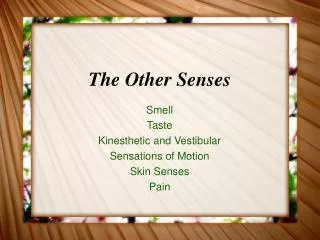
This section explores the intricate workings of the senses, focusing on smell, taste, and the body’s sensory feedback systems. Smell relies on receptor neurons in the nostrils, heavily influencing taste and flavor perception. Taste is detected through specialized receptors in taste buds, influenced by complexity and sensitivity. Skin senses, including pressure, temperature, and pain, are explained along with key concepts like prostaglandins and the gate theory of pain. The vestibular and kinesthetic senses inform our balance and body movement awareness, showcasing the depth of sensory interaction.

Understanding the Complexities of the Human Senses: Smell, Taste, and Body Awareness
E N D
Presentation Transcript
Other Senses Chapter 4 Section 4
Smell • Substances are detected through receptor neurons in each nostril. These receptors send information about the odors to the brain via the olfactory nerve. • Dogs use 7 times as much of their cerebral cortex for smell as people do. • Without the sense of smell, you would not be able to taste as much as you do. • Sense of smell adapts rapidly and we lose awareness
Taste • Taste is sensed through receptor neurons in the taste buds of the tongue. • Flavor of food is vey complex and also relies on temperature, odor, and texture. • Taste cells may be damaged by hot foods or scraping your tongue, but reproduce rapidly (usually a week) and it is very rare for someone to lose their sense of taste • 4 taste qualities- sweet, salty, sour, bitter • Some are more sensitive to different tastes that others • Dogs taste sweetness and cats do not
Skin Senses A combination of pressure, temperature, and pain. Pressure- sensory receptors around the roots of hair cells fire when the skin is touched and other structures beneath the skin are sensitive to pressure.
Skin Senses Temperature – normal body temperature is 98.6 receptors just beneath the skin help control temperature and adapt to increases and decreases in temperature occur.
Skin Senses Pain – Not all areas of the body are equally sensitive to pain. The more pain receptors in a certain area the more sensitive that area is. prostaglandins – chemicals that help the body transmit pain messages to the brain (ibuprofen, aspirin, etc. curbs production of prostaglandins) Gate theory- rubbing or scratching an injured area transmits sensation to the brain that compete with the pain messages for attention and neurons cannot get their pain messages to the brain. Phantom limbs – feeling pain or sensations in limbs that are no longer present. This is activated by neural circuits that have memories connected with the amputated limb.
Body Senses • Vestibular Sense – tells you whether you are physically upright without having to use your eyes. Also makes you aware of falling and change in acceleration. • Sensory organs in your ears monitor position and gravity
Kinesthesis – informs one of the position and motion of their body. • Sensory organs in the joints, tendons, and muscles send this information to the brain

![Smart [ er ] Event | Spectacles | Other Senses](https://cdn1.slideserve.com/2660866/slide1-dt.jpg)
![Smart [ er ] Event | Spectacles | Other Senses](https://cdn1.slideserve.com/2775840/slide1-dt.jpg)
![Smart [ er ] Event | Spectacles | Other Senses](https://cdn1.slideserve.com/2818725/slide1-dt.jpg)
![Smart [ er ] Event | Spectacles | Other Senses](https://cdn1.slideserve.com/2891832/slide1-dt.jpg)

![Smart [ er ] Event | Spectacles | Other Senses](https://cdn3.slideserve.com/5788041/slide1-dt.jpg)
![Smart [ er ] Event | Spectacles | Other Senses](https://cdn3.slideserve.com/6515946/slide1-dt.jpg)