Exploring Hybrid Partitioning in Simultaneous Multi-Threading Architectures
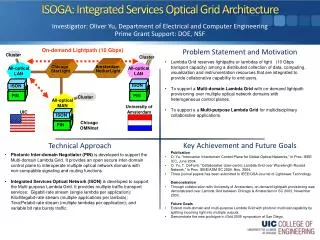
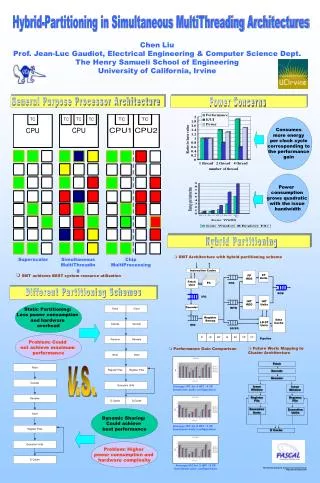
This paper presents a comprehensive analysis of hybrid partitioning schemes in superscalar simultaneous multi-threading (SMT) architectures, addressing power consumption challenges in general-purpose processors. The research examines how power grows quadratically with issue bandwidth and evaluates different partitioning strategies, highlighting the advantages of static partitioning in terms of reduced power consumption and hardware overhead. Future work involves mapping these architectures to cluster setups to maximize performance. Key findings include average IPC comparisons across various configurations and performance trade-offs in decoder and instruction fetch units.

Exploring Hybrid Partitioning in Simultaneous Multi-Threading Architectures
E N D
Presentation Transcript
Hybrid-Partitioning in Simultaneous MultiThreading Architectures Chen LiuProf. Jean-Luc Gaudiot, Electrical Engineering & Computer Science Dept.The Henry Samueli School of EngineeringUniversity of California, Irvine General Purpose Processor Architecture Power Concerns Consumes more energy per clock cycle corresponding to the performance gain Power consumption grows quadratic with the issue bandwidth Hybrid Partitioning SMT Architecture with hybrid partitioning scheme Superscalar Simultaneous MultiThreading Chip MultiProcessing Instruction Cache FP REG FP Units SMTachieves BEST system resource utilization PC PC PC Fetch Unit PC PC FPQ Different Partitioning Schemes ROB IFQ INT REG INT Units Static Partitioning: Less power consumption and hardware overhead Decoder INTQ Data Cache Register Remap LD-ST Units IDQ LQ/SQ Problem: Could not achieve maximum performance Pipeline • Future Work: Mapping to Cluster Architecture Performance Gain Comparison Fetch V.S. Decode Rename Average IPC for 4 INT / 4 FPfunctional units configuration Issue Window Issue Window Register File Register File Execution Units Execution Units Dynamic Sharing: Could achieve best performance Average IPC for 8 INT / 4 FP functional units configuration D Cache Problem: Higher power consumption and hardware complexity Average IPC for 8 INT / 8 FP functional units configuration The PArallel Systems & Computer Architectures Lab http://pascal.eng.uci.edu