Exploring the Fundamental Elements of Art: Lines, Shapes, Colors, and More
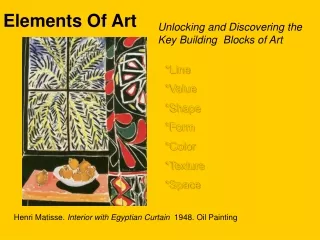
Dive into the world of art as we explore the essential elements that define creative expression. Discover how a line, a simple continuous mark, creates dynamic movements on a surface. Learn about shape, the enclosed area defined by boundaries, and how color reflects light to create visual impact. We'll unravel form as a three-dimensional figure contrasting with flat shapes, examine texture in tactile and visual contexts, and understand the importance of value in art, particularly in monochromatic works. Thank you for joining me on this artistic journey!

Exploring the Fundamental Elements of Art: Lines, Shapes, Colors, and More
E N D
Presentation Transcript
Elements of art Element of art By- Jonathan T.
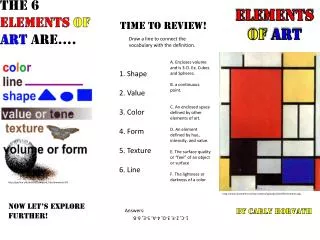
line A line is a basic element of art referring to a continuous mark made on a surface by a moving point.
shape A shape is an element of art specifically it is an enclosed shape boundaries of which defined by other elements of art.
color Color is the element of art that is produced when light striking an object is reflected back to the eye.
form • Form is a element of art at it’s most basic, a form is a three dimensional geometrical figure as opposed to a shape which is two dimensional or flat.
texture • Texture another element of art is used to describe either the way a three-dimensional work actually feels when touched or the visual feel of a two- dimensional work.
value Value refers to the lightness or darkness of a color. Value becomes critical in a work which has no colors other than black, white, and gray scale.
The End • Thank you for watching my show