Download
1 / 35
350 likes | 491 Vues
This comprehensive guide explores inverse trigonometric functions, specifically arcsine, arccosine, and arctangent. Learn how to restrict the domains of sine, cosine, and tangent functions to establish their inverses. The guide details the properties of these functions, including their increasing behavior and full range of values. We’ll also evaluate specific values of inverse trigonometric functions and use these concepts to find missing coordinates on graphs. Practical examples and graphical representations help solidify understanding of inverse relationships in trigonometry.

E N D
What could we restrict the domain to so that the sine function does have an inverse? 1 -1
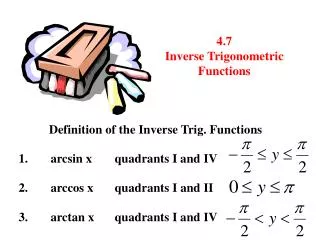
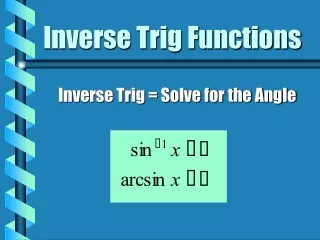
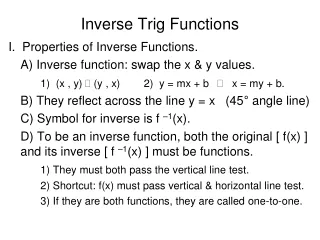
Inverse Sine, , arcsine (x) • Function is increasing • Takes on full range of values • Function is 1-1 • Domain: • Range:
Evaluate: arcSin • Asking the sine of what angle is
Find the following: • ArcSin • ArcSin
Inverse Cosine Function • What can we restrict the domain of the cosine curve to so that it is 1-1? 1 -1
Inverse Cosine, , arcCos (x) • Function is increasing • Takes on full range of values • Function is 1-1 • Domain: • Range:
Evaluate: ArcCos (-1) • The Cosine of what angle is -1?
Evaluate the following: • ArcCos
ArcTan (x) • Similar to the ArcSin (x) • Domain of Tan Function: • Range of Tan Function:
arcCos (0.28) • Is the value 0.28 on either triangle or curve? • Use your calculator:
Use an inverse trig function to write θ as a function of x. 2x θ x + 3
Find the exact value of the expression. Sin [ ArcCos ]
So far we have: • Restricted the domain of trig functions to find their inverse • Evaluated inverse trig functions for exact values • Found missing coordinates on the graphs of inverses • Found the exact values of compositions
Composition of Functions • Evaluate innermost function first • Substitute in that value • Evaluate outermost function
Sin (arcCos ) Evaluate the innermost function first: arcCos ½ = Substitute that value in original problem
How do we evaluate this? Let θ equal what is in parentheses
13 12 θ 5
13 12 How do we evaluate this? θ 5 Let θ equal what is in parentheses Use the triangle to answer the question
What is different about this problem? Is 0.2 in the domain of the arcSin?