Understanding Mineral Groups: Composition and Classification of Earth’s Crust
120 likes | 249 Vues
Nearly 4,000 minerals have been discovered, yet only a few dozen are abundant, forming the rocks of Earth’s crust. These rock-forming minerals are categorized into seven main groups: 1) Silicates 2) Carbonates 3) Sulfates 4) Oxides 5) Halides 6) Sulfides 7) Native Elements. Silicates, rich in silicon and oxygen, dominate the crust, while carbonates, sulfates, oxides, and halides each have unique compositions and significance. Understanding these mineral groups is crucial for geology, mining, and environmental studies.


Understanding Mineral Groups: Composition and Classification of Earth’s Crust
E N D
Presentation Transcript
Mineral Groups Nearly 4000 minerals have been discovered and named; however, no more than a few dozen are abundant. These few dozen makes up most of the rocks that comprise Earth’s crust. This is why we call them the rock-forming minerals. Minerals that form the rocks within Earth’s crust belong to seven (7) main mineral groups, which include: 1) Silicates 2) Carbonates 3) Sulfates 4) Oxides 5) Halides Reference: Tarbuck and Lutgens Pages 44 - 55 6) Sulfides 7) Native Elements
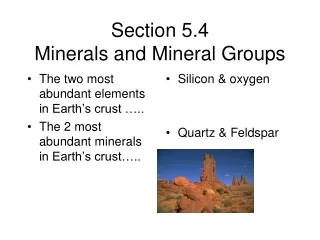
Do You Remember? • Do you remember the eight elements that make up more than 98 % of Earth’s crust (i.e. continental crust)? List them. • Which two elements are most abundant in Earth’s crust? Oxygen and Silicon. • Both comprise nearly three-fourths of Earth’s continental crust. Both elements combine to form the framework of the most common mineral group (i.e. the silicates). • The framework is called the silicon-oxygen tetrahedron.
Mineral groups that end with “ate” and have an oxygen group in its chemical formula are one of the following; Silicates = Si + Oxygen Sulfates = S + Oxygen Carbonates = C + Oxygen Hints To Classify Mineral Groups Olivine (Mg,Fe)2SiO4 Barite BaSO4 Calcite CaCO3
Mineral groups that end with “ide” and have a metal (e.g., Na, K) in its chemical formula are one of the following; Oxides = Metal + O Sulfides = Metal + S Halides = Metal + Cl, Br, F Hints to Classify Mineral Groups Hematite Fe2O3 Pyrite FeS2 Fluorite CaF2
1) Silicates Mineral Groups • A mineral group that has silicon and oxygen as part . of their atomic structure. • Comprise more than 96% of the crust (most common mineral group). Rock forming silicates are divided into two groups: • Sialic Silicates (Aluminosilicates) • Rich in silicon and aluminum. • Comprise about 85% of the silicates in the crust. • Mineral are light in color. Examples include: Quartz Mica (Muscovite) Feldspar
1) Silicates (Continued) Mineral Groups • Simatic Silicates • Rich in silicon and magnesium. • Comprise less than 15% of the silicates in the crust. • Minerals are dark in colour. Examples include: Olivine Pyroxene Amphibole
2) 3) Carbonates Sulfates • compounds consisting of an atomic structure of one sulfur and four oxygen (SO4). Mineral Groups • compounds consisting of an atomic structure of one carbon and three oxygen (CO3). • most common carbonate mineral is calcite (Ca CO3), which makes up the chemcial sedimentary rock called limestone as well as the metamorphic rock called marble. • the rock gypsum is an example of a sulfate and it also takes on the mineral name. (CaSO4• 2H2O) • The mineral barite (BaSO4) is mined and used in drilling mud.
4) 5) Oxides Halides • compounds consisting of an atomic structure of chlorine or fluorine with sodium, potassium, or calcium. Mineral Groups • compounds consisting of an atomic structure of oxygen combined with one or more metals. • most common oxides are those of iron (Fe2O3) and aluminum (Al2O3); referred to as the Ore Minerals. As an example, the mineral hematite is Fe2O3 • Halite (NaCl) is the most common halide. It is often referred to as table salt.
6) 7) Sulfides Native Minerals • elements that occur uncombined in nature. • commonly called native elements. Mineral Groups • compounds consisting of an atomic structure of one or more metals combined with sulfur. • examples of minerals include: pyrite (FeS2), galena (PbS), and sphalerite (ZnS). • examples include: gold (Au), silver (Ag), copper (Cu), and sulfur (S).
NOTE • Note that an ore mineral is any mineral that has enough of a particular element in it to be mined at a profit. $
Sample Problem Which is an example of a halide? (A) barite (BaSO4) (B) calcite (CaCO3) (C) fluorite (CaF2) (D) hematite (Fe2O3)