Join Us for a Dinner and Sestina Poetry Reading Night!
You're invited to a cozy dinner this Friday at my apartment, located just 25 meters south of the Nazca restaurant. We'll be enjoying good food and diving into the world of sestinas, a unique poetic form. Bring something to share if you like, but it’s not mandatory! Sign up to let us know what you’ll be bringing. Let's explore the beauty of linked poetry together while enjoying a warm meal. Looking forward to an evening of creativity and community!

Join Us for a Dinner and Sestina Poetry Reading Night!
E N D
Presentation Transcript
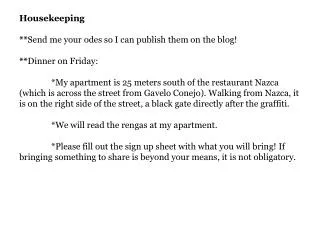
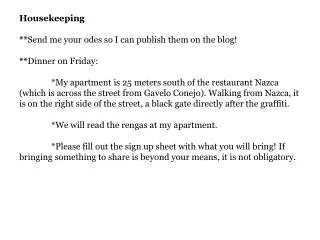
Housekeeping**Send me yourodesso I can publishthemonthe blog!**Dinneron Friday:*My apartmentis 25 meterssouth of the restaurant Nazca (whichisacrossthestreetfromGavelo Conejo). Walkingfrom Nazca, itisontherightside of thestreet, a blackgatedirectlyafterthegraffiti. *Wewillreadthe rengas at my apartment. *Pleasefilloutthesign up sheetwithwhatyouwillbring! Ifbringingsomethingto share isbeyondyourmeans, itisnotobligatory.
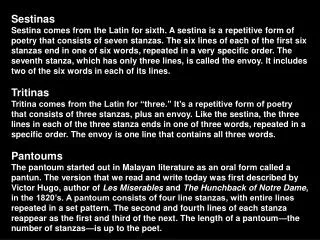
Sestinas A sestina is a 39-line linked poetic form believed to have been invented by Arnaut Daniel (c. 1180-1200), aProvençal troubador poet who inspired Dante such that he appears in The Purgatory as a model for the vernacular poet. Here is what people mean by “linked.” Instead of there being a rhyme scheme or even a set meter like many other fixed forms of poetry, a sestina follows to a set pattern of end-words, or teleutons, which appear at the end of each line. Sestinas are structured into six six-line stanzas. The initial end words of each of these six stanzas are then repeated in a specific pattern as end words in each subsequent stanza. The poem ends with a final three-line stanza, or envoi, which uses all six end-words as a triumphant send-off.
Sestina format: • 1 2 3 4 5 6 • 6 1 5 2 4 3 • 3 6 4 1 2 5 • 5 3 2 6 1 4 • 4 5 1 3 6 2 • 2 4 6 5 3 1 • 2/5 , 4/3, 6/1
Tips: • It is important to pick good repetition words. Words with more than one meaning are useful. Punning is perfectly acceptable. • You can use enjambment- a sentence or clause does not have to end at the end of the verse or stanza. • Depending on how strict you want to stay to the structure, you could choose to: • Interchange homophones with your end words. For example, if one of your end words is ¨through¨you could also use ¨threw¨in its place. • You can change the tense or subject of the verb. For example, ¨talk¨could become ¨talks¨or ¨talked.¨ • The frequent repetition of words in emphasised positions tends to give the sestina an obsessive flavour. Some of the best sestinas in English use this to evoke a sinister atmosphere.