Transducer
This detailed overview of transducers explores their essential role in converting one form of energy into another, highlighting various types such as active, passive, analog, and digital transducers. It delves into the principles behind thermoelectric, magneto-resistive, piezoelectric systems, and more. Special attention is given to pressure, vibration, and velocity measurement transducers, alongside descriptions of specific devices like manometers, Bourdon tubes, and accelerometers. Discover how these devices are crucial in industrial applications and measurement accuracy across various physical quantities.

Transducer
E N D
Presentation Transcript
Transducer Device when activated from one form energy converted to another quantity or Device which converts one physical quantity or condition to another
Physical quantity – heat , intensity of light, flow rate, liquid level, humidity etc Sensor : sense physical quantity
Classification of transducers • Based on principle of transduction • Active & passive • Analog & digital • Inverse transducer
Based on principle used • Thermo electric • Magneto resistive • Electro kinetic • Optical
Passive transducer Device which derive power reqd. for transduction from auxiliary power source - externally powered Eg : resistive, inductive, capacitive Without power they will not work
Active transducer • No extra power reqd. to produce I/p • Self generating • Draw power from input applied • Eg. Piezo electric x’tal used for accelartion measurement
Analog transducer • convert I/p quantity into an analog o/p • Analog o/p- a continuous fn. Of time • Eg. Strain gauge, L VDT, thermocouple
Digital transducer • Converts I/p into an electrical o/p in the form of pulses
Inverse transducer • Which converts electrical signal to physical • quantity
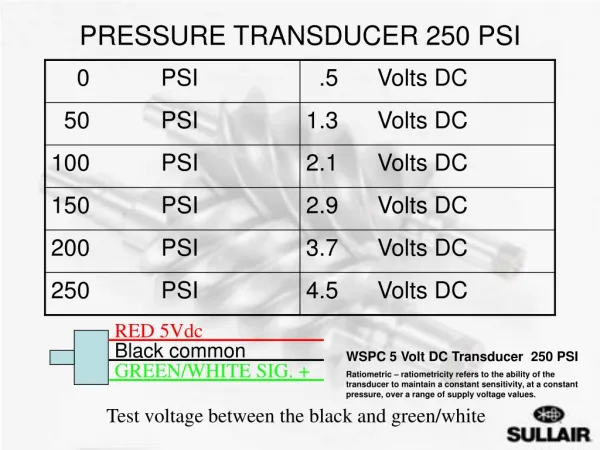
Transducer for pressure measurement • What is pressure? force/ unit area Unit – (N/sq.m) Pa Pressure measured can be absolute , gauge or differential depending on type of reference
Types of pressure transducers • Gravitational eg : manometer • Elastic – force converted to strain eg. Diaphragm, capsule, bellows, bourdon tubes
Diaphragm Common pressure sensing elastic element Thin circular plate stretched & fastened at its periphery Made of elastic alloys of bronze,phosphor bronze, stainless steel or alloys like Monel, Nickel span -C
Flat type – high natural frequency • Corrugated – for large deflections
Capsule • Two corrugated metal diaphragms sealed together at periphery • Forms a shell like structure • One diaphragm has a port at centre to admit pressure to be measured • Other diaphragm linked to a moveable mechanical part.
Capsule • Displacement proportional to difference b/w outer & inner pressure.
Bourdon tubes • curved or twisted metallic tubes with elliptical cross section • Sealed at one end • Tends to straighten when pressure applied. • Angular sensitivity proportional to pressure applied
Helical type • Tube in the form of helix
Bourdon tube • More sensitive to shock & vibrations • Good repeatability
Bellows • Thin walled cylindrical sheets with deep convolutions sealed at one end • Sealed end moves axially when pressure is applied • No. of convolution s – vary from- 2 to 50 – depends on range, operating temp • Used for low pressure measurement
Bellows displacement y = 2.n. A q P Rx2 /( Et2 .) where n – no. of convolutions A q- effective area Et - young’s modulus of elasticity Rx – radius of diaphragm P – pressure ie, Y P
Resistive type Eg. Strain gauge
Inductive type • Eg. LVDT
Measurement of velocity Velocity – linear or angular
Linear velocity • Electromagnetic transducers • O/p voltage E = /t • = N I/ R2 . dR/dt where N I/ R2 is a constant R- reluctance so E proportional to reluctance R proportional to air gap & air gap proportional to velocity
Types • Moving coil • Moving magnetic
Angular velocity • Tachometer - types Mechanical Electrical MHD sensor – magneto hydrodynamic sensor highly sensitive High precision
Transducer for vibration • Vibrations give early warning of impending conditions which may develop &vlead to complete failure & destruction of equipment • Used in power plants, turbines
Most vibrations are sinusodial in nature • Got amp & freq. • Amp gives displacement • By measuring displacement, velocity or acceleration - vibrations measured
Vibration transducer Accelometer – measures shock or vibration Pot type or LVDT type