Download
1 / 5
50 likes | 189 Vues
This study explores the intricate relationship between kin selection, altruism, and the influence of maternal perinatal association (MPA) on human interactions. It investigates how humans identify genetic similarity in mates and exhibit altruism towards relatives. Using a sample of 154 participants, the research compares self-reported data from men and women regarding co-residence and MPA effects on altruistic behavior. The implications for understanding human social structures and moral opposition in kinship contexts are examined, contributing valuable insights to evolutionary psychology.

E N D
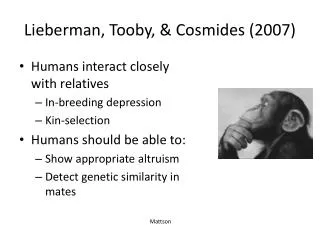
Lieberman, Tooby, & Cosmides (2007) • Humans interact closely with relatives • In-breeding depression • Kin-selection • Humans should be able to: • Show appropriate altruism • Detect genetic similarity in mates Mattson
Sibling Detection • Maternal Perinatal Association (MPA) • Co-residence and other factors Mattson
Co-residence and MPA • N=154 at lowest • Self-Report • Men vs. Women • Notable changein effect size Mattson
Co-residence and MPA • Effect of MPA vs. Co-residence on • Altruism • Incest • After controlling for MPA Mattson
Alternatives and Conclusions • Data Artifact? • Moral opposition linked to opposite sex co-residence • Early Imprinting? • Likely due to MPA • Beliefs? • Not predictive compared to co-residence • Correlational • Kinship Index • Hierarchy of Cues Mattson