GARA Bandwidth Broker Implementation: Enabling High-Performance TCP Flows
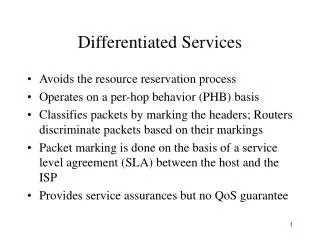
Learn about the GARA architecture to provide quality of service for high-end applications through differentiated services and network resource management. Explore features like resource discovery, admission control, and network QoS implementation. Dive into experiments and evaluation tools for UDP and TCP flows.

GARA Bandwidth Broker Implementation: Enabling High-Performance TCP Flows
E N D
Presentation Transcript
A Differentiated Services Implementation for High-Performance TCP Flows Volker Sander, Ian Foster, Alain Roy and Linda Winkler Forschungszentrum Jülich GmbH Argonne National Laboratory The University of Chicago
Outline • The GARA quality of service architecture • GARA and network quality of service • Experimental results • Summary and future directions 23-May-2000, TNC 2000
GARA • General-purpose Architecture for Reservation and Allocation • Developed as part of the Globus Project • www.globus.org • Globus Toolkit provides enabling security and directory services • Otherwise independent of Globus • Goal: Provide end-to-end Quality of Service (QoS) to high-end applications 23-May-2000, TNC 2000
Example High-end Applications • Teleimmersion: Virtual reality collaboration • Distributed Scientific Computing • Analysis of large data sets • Real-time simulation steering • Remote control of scientific instruments • Real-time visualization • Collaboration: Multiple people visualizing & steering • We have to address UDP and TCP flows 23-May-2000, TNC 2000
How does GARA Help? • Resource discovery • Network • Computers • Disks • Advance reservations • Security: control over who gets reservations • Monitoring of reservations • Coordination of multiple reservations } Not just Network QoS! 23-May-2000, TNC 2000
Resource Manager • The Resource Manager is the core of GARA • Admission control • Configures resource • Monitors resource • Assumes exclusive access to the resource • Otherwise no guarantees can be made GARA’s network resource manager is a Bandwidth Broker 23-May-2000, TNC 2000
Network Resource Manager • Admission control • Has knowledge of topology within a domain • Tracks reservations on path through domain • Configures routers • Differentiated services (more detail soon) • Currently telnet with command-line interface • COPS/SNMP in the future • Monitors resource • Query edge router for flow statistics • Conforming and exceeding (dropped) packets 23-May-2000, TNC 2000
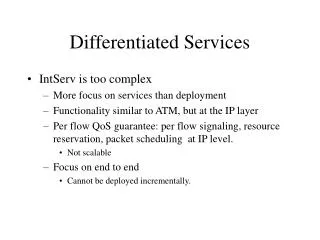
Network QoS Implementation • We use differentiated services • Expedited forwarding to implement “premium service” • We use Cisco 7507 routers (thanks Cisco!) • Edge routers controlled with resource manager, as described above • Packets that exceed the reservation are dropped 23-May-2000, TNC 2000
The GARNET Testbed 23-May-2000, TNC 2000
Evaluation Tools • UDP Traffic Generator • Modified Version of Andy Adamson’s gen_send and gen_recv • Evaluate admission control • Creating competing traffic • MGEN/Drec • Evaluate Delay and Jitter for Premium UDP Flow • IPERF • Modified Version of ttcp • GARA-enabled (wait for reservation) • Support for a desired application rate • Consecutive bandwidth reporting • Bulk transfer ttcp 23-May-2000, TNC 2000
Basic Experiment I UDP Receiver UDP Sender GARA Diffserv Resource Manager 23-May-2000, TNC 2000
Basic Experiment I • Goal: Proof of Admission Control 23-May-2000, TNC 2000
Basic Experiment II UDP Reveiver UDP Sender UDP Sender UDP-Realtime- Receiver GARA Diffserv Resource Manager 23-May-2000, TNC 2000
Basic Experiment II • Goal: Demonstrate Low-Latency for UDP flows 23-May-2000, TNC 2000
TCP Issue:Exceeding the Reservation 45 Slow Start Exponential Growth 40 35 Congestion Control Linear Growth 30 25 TCP Congestion Window Size 20 15 10 5 0 0 time 23-May-2000, TNC 2000
UDP Sender Basic Experiment III UDP Receiver TCP Receiver GARA Diffserv Resource Manager TCP Sender 23-May-2000, TNC 2000
Conclusions for Implementing a Bandwidth Broker • Avoid any drops if you care about short-term impact • Instead use feedback mechanisms to inform the application / the agent to adapt • its transmission rate • its reservation 23-May-2000, TNC 2000
TCP Issue II • TCP’s Flow Control • Traffic might become bursty if the actual window size is large • Bandwidth*Latency product as minimum window size 23-May-2000, TNC 2000
Demonstration of TCP’s Burstiness 23-May-2000, TNC 2000
Conclusions for Implementing a Bandwidth Broker • Be aware of burstiness • Token bucket depth should allow a full window burst T = Reserved_BW * Estimated_RTT Or implement signaling from the application • How does this interfere with UDP low-latency flows in one aggregate behavior? 23-May-2000, TNC 2000
Basic Experiment IV UDP Receiver UDP Sender UDP-RT Receiver UDP Sender TCP Sender TCP Receiver GARA Diffserv Resource Manager 23-May-2000, TNC 2000
99% WFQ, No Traffic Shaping 23-May-2000, TNC 2000
Conclusions for Implementing a Bandwidth Broker • If Traffic Shaping is not possible, guarantee as much bandwidth to the premium flow as possible. • Admission Control is performed at the edge BUT: Be aware of default queue limits 99% WFQ BW results in a maximum increase of RTT by RTT/2 (assuming 33% EF-Traffic) 23-May-2000, TNC 2000
Standard BE Behavior 23-May-2000, TNC 2000
WFQ: Default Buffer - Just BE 23-May-2000, TNC 2000
WFQ: Modified Buffer - Just BE 23-May-2000, TNC 2000
TCP & Low-Delay Flows • TCP can interfere with UDP flows that want low-delay: • We want traffic shaping to smooth out premium bursts • TCP can be very bursty • Solution: • Traffic Shaping (but…) 23-May-2000, TNC 2000
Traffic Shaping for Entire Premium Class 23-May-2000, TNC 2000
TCP & Low-Delay Flows • Aggregate-based traffic shaping adds delays for low-delay UDP traffic • Solution: • Don’t use a single traffic-shaping configuration for the entire premium class 23-May-2000, TNC 2000
QoS Mechanisms: Inside the Ingress Router 23-May-2000, TNC 2000
Dynamic Traffic Shaping 23-May-2000, TNC 2000
When a reservation ends, the bulk-transfer speeds up When a reservation begins, the bulk-transfer backs off The competitive UDP traffic never interferes Bulk Transfer (LAN) 23-May-2000, TNC 2000
Bulk Transfer (WAN) 23-May-2000, TNC 2000
Then CPU becomes loaded Until competition begins Finally, we turn off network reservation We reserve net We reserve CPU Initially easy to get 80 Mbps Network + CPU Reservations 23-May-2000, TNC 2000
Current Status • A working GARA prototype exists • Differentiated Services • Real-Time CPU Scheduling (DSRT) • DPSS Disk Access • Integrated security, resource discovery, etc. • Many experiments have been performed • Expedited Forwarding is working • Work with early adopters has started • E.g., DOE labs, MREN universities, NASA 23-May-2000, TNC 2000
Future Work • Technology development • More work on Co-reservations • Policy issues: Who has access when; costs, accounting; priorities, preemption • COPS interfaces, inter-domain issues • Experimentation with more real applications • Higher bandwidth flows • MPLS, wavelength allocation 23-May-2000, TNC 2000
Questions? • Feel free to email us: • Volker Sander: v.sander@fz-juelich.de • Ian Foster: foster@mcs.anl.gov • Alain Roy: roy@mcs.anl.gov • Linda Winkler: winkler@mcs.anl.gov • Check our web site: • http://www.mcs.anl.gov/qos/ • Numerous technical papers available 23-May-2000, TNC 2000