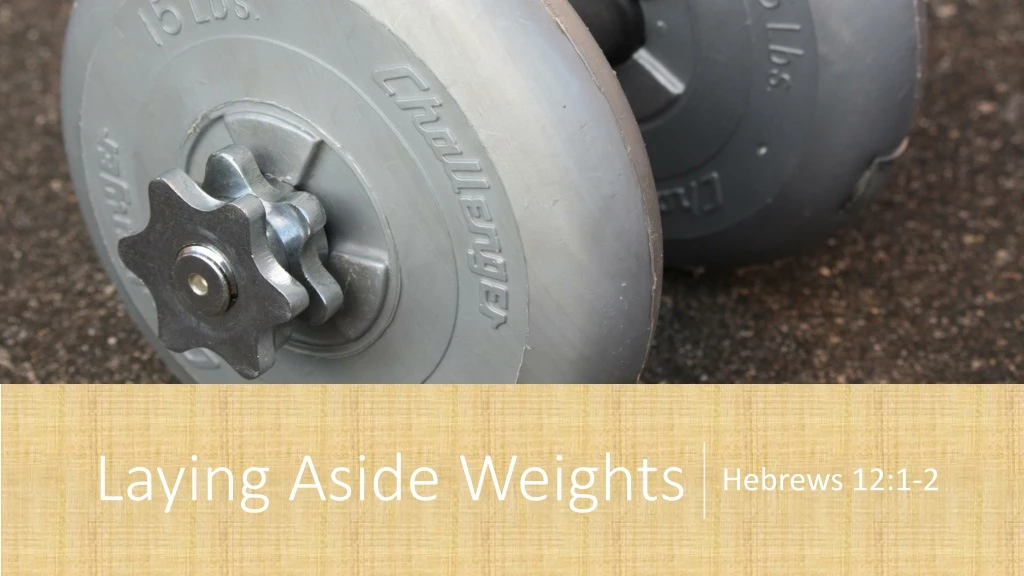

Laying Aside Weights
E N D
Presentation Transcript
Laying Aside Weights Hebrews 12:1-2
Introduction • Urging believers to run the Christian race with endurance, the Hebrew writer says, “Let us also lay aside every encumbrance and the sin which so easily entangles us” (Heb. 12:1-3).
Lay Aside Every Weight • The Greek word ogkos, occurring only here, and translated “weight” (KJV) or “encumbrance” (NASB), refers to “bulk, an encumbrance” (Thomas 3591). • BDAG define it as “(1) material that is ponderously large, bulk; (2) that which hinders one from doing something, weight, burden, impediment, a figurative extension of 1.” • In Hebrews 12:1, it can be rendered “setting aside everything that serves as a hindrance” (13.149).
Lay Aside Every Sin • The Greek word euperistatos, occurring only here, and translated “ensnares” (KJV) or “encumbrance” (NASB), refers to that which is “easily encircling” (Thomas 2139). • BDAG define it as “easily ensnaring, obstructing, constricting.” • In Hebrews 12:1, it may be rendered “the sin which controls (us) so tightly” (37.6).
Weight of Worry • We should lay aside the weight of worry resulting from either a lack of faith or the unnecessary compounding of past, present and future troubles (Matt. 6:25-34). • While worry is not inherently sinful, it can become so (Matt. 13:22; Luke 10:38-42), and is most certainly burdensome (2 Cor. 11:23-28, esp. v. 28; Col. 2:1-2).
Weight of Worldliness • We should lay aside the weight of worldliness (1 John 2:15-17).
Lust of the Flesh • Consider the consequences that King David faced because of his sin with Bathsheba (2 Sam. 12:7-15). • In addition to the external judgments, he bore a heavy burden of guilt: “When I kept silent about my sin, my body wasted away through my groaning all day long. For day and night Your hand was heavy upon me; my vitality was drained away as with the fever heat of summer” (Psa. 32:1-5).
Lust of the Eyes • Consider the burden of being consumed by a love of money: “Those who want to get rich fall into temptation and a snare and many foolish and harmful desires which plunge men into ruin and destruction” (1 Tim. 6:7-10, 17-19). • The Greek word buthizō, here translated “plunge,” means “to sink, to cause to sink” (Thomas 1036).
Sinking Ships & Spiritual Ruin • Elsewhere, it is used of Simon Peter’s boat that began to sink because of the great quantity of fish that had been caught (Luke 5:4-8, esp. v. 7). • So likewise, we may sink into spiritual ruin from being weighed down with materialistic desires. It is figuratively descriptive of the disastrous consequences of covetousness.
A Worthy Alternative • Instead of obsessing over earthly treasures that perish, become defiled and fade away, let us store up treasures in heaven that will endure for all eternity (1 Tim. 6:17-19; 1 Pet. 1:3-5).
Pride of Life • Consider the burdensome consequences of pride, denounced throughout Sacred Scripture, but especially in the Wisdom Literature of the Old Testament (Prov. 8:13; 11:2; 14:16; 15:25; 16:5, 18-19; 21:24; 28:25; 30:11-14).
Definition of Weight • Reflecting the Hebrew writer’s exhortation, “let us lay aside every weight” (KJV) or “encumbrance” (NASB), we noted BDAG’s definition: “(1) material that is ponderously large, bulk; (2) that which hinders one from doing something, weight, burden, impediment, a figurative extension of 1.”
Illustration • Illustrating the first definition, “material that is ponderously large,” BDAG cite an occurrence of the word by Papias, an early Christian writer, who referred to “the bulk of the head.” • In all, an adult head weighs around 10 to 11 pounds.
The Problem • Figuratively speaking, some folks “jus got da big head.” • The Corinthian disciples were being weighed down and held back by manifestations of their overweening pride, as they pitted one brother against another (1 Cor. 4:6), tolerated rank immorality in their midst (1 Cor. 5:1-2), and used knowledge as a whipping stick (1 Cor. 8:1-3).
The Solution • They needed to learn that agape love “does not brag and is not arrogant” (1 Cor. 13:4-7). • While God bestows abundant grace, He does so conditionally, opposing the proud, but giving grace to the humble (James 4:6).
Conclusion • As illustrated in the life of Moses, we need the assistance of others, whether it be in the form of a helping hand (Exod. 17:8-16), or by sharing responsibilities (Num. 11:10-30). • As is illustrated in the life of David, we need the assistance of God, both in the form of divine forgiveness (Psalm 38, esp. vv. 4, 17-18), and divine assistance (Psalm 55, esp. vv. 1-2, 22).
Challenge • Jesus offers deliverance from our burdens: “Come to Me, all who are weary and heavy-laden, and I will give you rest. Take My yoke upon you and learn from Me, for I am gentle and humble in heart, and you will find rest for your souls. For My yoke is easy and My burden is light” (Matt. 11:28-30).