
Leonard Euler (1707-1783)
E N D
Presentation Transcript
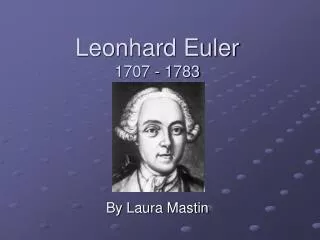
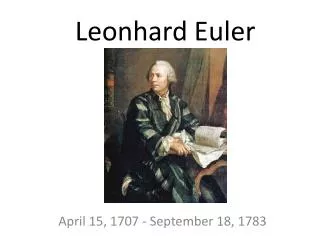
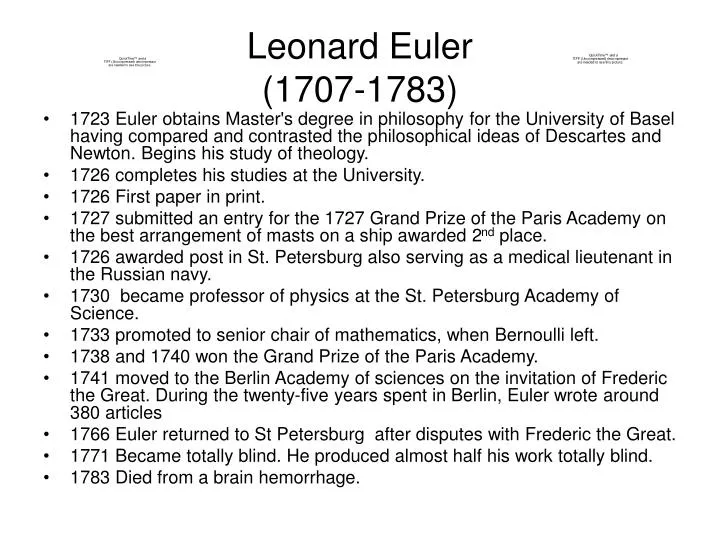
Leonard Euler (1707-1783) • 1723 Euler obtains Master's degree in philosophy for the University of Basel having compared and contrasted the philosophical ideas of Descartes and Newton. Begins his study of theology. • 1726 completes his studies at the University. • 1726 First paper in print. • 1727 submitted an entry for the 1727 Grand Prize of the Paris Academy on the best arrangement of masts on a ship awarded 2nd place. • 1726 awarded post in St. Petersburg also serving as a medical lieutenant in the Russian navy. • 1730 became professor of physics at the St. Petersburg Academy of Science. • 1733 promoted to senior chair of mathematics, when Bernoulli left. • 1738 and 1740 won the Grand Prize of the Paris Academy. • 1741 moved to the Berlin Academy of sciences on the invitation of Frederic the Great. During the twenty-five years spent in Berlin, Euler wrote around 380 articles • 1766 Euler returned to St Petersburg after disputes with Frederic the Great. • 1771 Became totally blind. He produced almost half his work totally blind. • 1783 Died from a brain hemorrhage.
Leonard Euler (1707-1783) • Studied number theory stimulated by Goldbach and the Bernoullis had in that topic. • 1729, Goldbach asked Euler about Fermat's conjecture that the numbers 2n + 1 were always prime. if n is a power of 2. Euler verified this for n = 1, 2, 4, 8 and 16 and, by 1732 that the next case 232 + 1 = 4294967297 is divisible by 641 and so is not prime. • We owe to Euler the notation f(x) for a function (1734), e for the base of natural logs (1727), i for the square root of -1 (1777), p for pi, S for summation (1755), the notation for finite differences Dy and D2y and many others. • Found a closed form for the sum of the infinite series z(2) = S (1/n2). Moreover showed that z(4) = p4/90, z(6) = p6/945, z(8) = p8/9450, z(10) = p10/93555 and z(12) = 691p12/638512875. And z (s) = S (1/ns) = P (1 - p-s)-1. • Euler also gave the formula eix= cos x + i sin x and ln(-1) =pi • In 1736 Euler published Mechanica which provided a major advance in mechanics • Also gave cases of n=3 (and n=4) for Fermat (with little mistakes), the Euler equation for of an inviscid incompressible fluid, investigating the theory of surfaces and curvature of surfaces, and much, much more …
Euler’s Solution for Exponent Four • He actually proves a little more: a4+b4=c2 has no solutions. His proof from Elements of Algebra. 202. Thm: There are neither solutions to x4+y4=z2 nor to x4-y4=z2 except if x=0 or y=0. 203. We may assume x and y are relatively prime. 204. Outline of the strategy. Use infinite descent. I.e. from any solution produce a smaller solution. But there are no solutions for small numbers.
Leonard Euler’s :Elements of Algebra 205. The case x4+y4=z2 (*) • If x,y relatively prime, then (A) either both odd or (B) one is odd and the other is even. • (A) is not possible: An odd square is of the form 4n+1 (If k=2m+1,k2=4(m2+m)+1). So the sum of two odd squares is of the form 4n+2. This means it is divisible by 2 and not by 4, so it is not a square. So the sum cannot be a square. But 4th powers are also squares, so the equation cannot hold. • (B) If (x,y,z) is a solution (x2)2+(y2)2=z2, then there are p,q such that x2=p2-q2and y2=2pq. • Moreover, y is even and x is odd. Then p is odd and q is even. Proof: First since x2=p2-q2, either p or q has to be odd and the other even. Also p cannot be even, since then p2-q2 would be of the form 4n-1 or 4n+3 and cannot be a square. (If p=2k and q2=4m+1, the p2-q2=4(k2-m)-1). • Now (x,q,p) is another Pythagorean triple x2=p2-q2, so there are r, s s.t. p=r2+s2, q=2rs, x=r2-s2. • 2pq=4rs(r2+s2)=y2 so 4rs(r2+s2) must be a square. Also r, s, and r2+s2 have no common prime factors (why?). • If the statement of VI holds all the factors -r,s, r2+s2- must be squares (why?). So there are t, u such that r=t2, s = u2. Also r2+s2=t4+u4 is a square and hence (t,u, (t4+u4)1/2) is a solution of (*). Since x2=p2-q2=(t4-u4)2, y=t2u2(t4-u4) it follows that x,y>t,u. So that if (x,y) yields a solution we have another solution (t,u) which is smaller. • Repeat step VII to obtain smaller and smaller. But there are no small solutions (except the ones with zeros). • But the smaller solutions from above are also non-zero. This yields a contradiction.
Euler and the case n=3 Consider x3+y3=z3 with relative prime (x,y,z) • Exactly one of the integers is even. • Say z is even and so x,y odd. Then x+y=2p and x-y=2q are both even. • Factorize x3+y3=(x+y)(x2-xy+y2). • Then by inserting x=p+q, y=p-q one finds that p,q have opposite parity are relatively prime and 2p(p2+3q2) has to be a cube. • The same conclusion is also true if z is odd. • (A) 2p and (p2+3q2) are relatively prime then they have to be cubes and Euler argues that there exist (a,b) such that p=a3-9ab2, q=3a2b-3b3. • Factor to obtain 2p=2a(a-3b)(a+3b) is a cube and show that the factors are relatively prime making them all cubes. Say 2a=a3,a-3b=b3,a+3b=g3. Then (b,g,a) is a new smaller solution. • This also works in a variation if 2p and (p2+3q2) are not relatively prime. The problem is in step 6. He does not show that this is the only way for (p2+3q2) to be a cube.