Quantum Image Processing and Compression: Enhancements Using Controlled Rotations and Polynomial Preparation
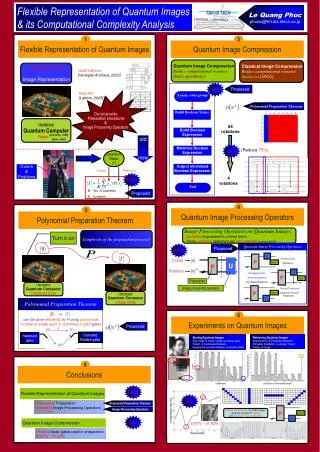
This work explores advancements in quantum image processing, focusing on flexible representation and quantum compression techniques. By implementing controlled rotations and polynomial preparation theorems, we reduce computational resource requirements for quantum hardware. Key findings include effective image representation through qubit lattices and optimized Boolean expressions, which facilitate efficient image processing operators. We discuss the implications of complexity analysis in quantum image retrieval and measurement, enhancing the application of quantum Fourier transforms and rotational gates in practical scenarios.

Quantum Image Processing and Compression: Enhancements Using Controlled Rotations and Polynomial Preparation
E N D
Presentation Transcript
U P Shifting Color (Rotation) Quantum State U P Hardware Quantum Computer Image State Hardware Quantum Computer Initialized state Changing Color at some positions (Controlled-Rotation) P P P Fourier Transform (Quantum Fourier Transform) U U 2 1 3 6 5 4 Flexible Representation of Quantum Images Polynomial Preparation Theorem Conclusions Quantum Image Compression Experiments on Quantum Images Quantum Image Processing Operators Flexible Representation of Quantum Images& its Computational Complexity Analysis Le Quang Phuc phuclq@hrt.dis.titech.ac.jp Quantum Image Compression Reduce computational resource (basic operations) Classical Image Compression Reduce computational resource (memory) [JPEG] What we need Image Representation Qubit Lattices [Venegas-Andraca, 2003] QIC Proposed Real Ket [Latorre, 2005] A same color group Do not provide Preparation procedures & Image Processing Operators Polynomial Preparation Theorem Build Boolean Terms Hardware Quantum Computer Faster 64 rotations Build Boolean Expression [Feynman, 1982] [Shor, 1994] old QIC Minimize Boolean Expression (Reduce 75%) new Output minimized Boolean Expression Colors & Positions Colors Positions FRQI 4 rotations End N – No. of positions K - Constant Proposed • Image Processing Operators on Quantum Images • -Invertible (expressed in unitary form) • Some classicaloperators are not invertible[Lomont,2003] Complexity of the preparation process? Turn it on FRQI Quantum Image Processing Operators Proposed Colors U Type I Positions Type II Preparation Image processing operators Type III Polynomial Preparation Theorem can be done efficiently by P using polynomial number of single qubit & controlled-2 qubit gates Proposed Controlled Rotation gates Hadamard gates • Storing Quantum Images • Gray Image Theta(i) (Angles encoding colors) • Theta(i) Controlleded Rotations • Hadamard & Controlled Rotations Quantum State • Retrieving Quantum Images • Measurements Probability Distribution • Probability Distribution estimate Theta(i) • Theta(i) Image FRQI Flexible Representation of Quantum Images QIC • Polynomial Preparation • Invertible Image Processing Operators • 3 Types Polynomial Preparation Theorem Image Processing Operators Simple line detection on binary image using the operator in type III with quantum Fourier transform Type III QIC Quantum Image Compression 6.67% ~ 31.62% • Reduce basic gates used in preparation • 6.67% ~ 31.62%