
Passive Movement Across Plasma Membrane - Nature of Biology
E N D
Presentation Transcript
Plasma Membranes Nature of Biology 2 page 11- 29
A new approach to three quick questions • We will continue to do the three quick questions this year. • Instead of answering them at the start of the lesson, we will approach them at the start independently, with everyone responding in their notebooks (back of the book) • At the end of the PowerPoint we will go over the three quick questions again
Three quick Questions Question 3 An example of passive movement across a plasma membrane is A. a macrophage engulfing a bacterium. B. goblet cells of the small intestine secreting mucus into the gut lumen. C. a freshwater unicellular organism gaining water from its natural surroundings. D. the axon of a neuron exchanging sodium and potassium ions when the cell is stimulated.
Study Design Plasma membranes • the fluid mosaic model of the structure of the plasma membrane and the movement of hydrophilic and hydrophobic substances across it based on their size and polarity
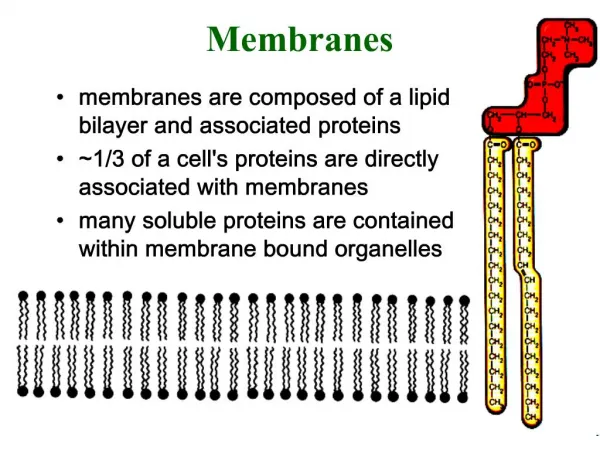
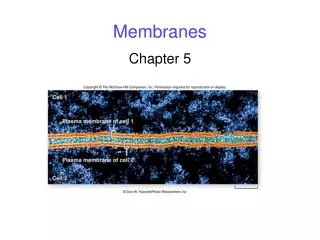
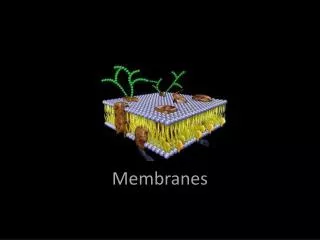
Structure • The plasma membrane is a structural organelle that encloses all of the contents of a cell acting as the division between intracellular and extracellular space. • A 7-9 nm thick phospholipid bilayer with associated proteins, carbohydrates and cholesterol (a lipid). • The fluid-mosaic model
Structure • A bilayer of phospholipids • A hydrophobic fatty acid (lipid) tail attached to a hydrophilic phospahte head
Functions • Permit selective control of molecules entering and leaving cells (semipermeable) • Protecting and separating the cell (intracellular) from its surroundings (extracellular) • Fluid structure allows for flexibility and changing shape with cholesterol intertwined in the tails to maintain the flexibility resisting temperature change
Proteins • Plasma membrane proteins can be grouped into four types: • Transport proteins (Channel/Carrier) assist in the movement of molecules which cannot simply cross the semipermeable membrane • Receptor proteins receive molecules (ligands) from the extracellular space which communicate with the cell • Recognition proteins (MHC markers) interact with molecules, cells and other agents identifying whether it is native or foreign • Adhesion proteins ensure cells can maintain close interaction between themselves and other cells or structures
Modes of transport - Passive • Passive – No Energy (ATP) requirement • Simple diffusion: small, uncharged, non-polar or hydrophobic molecules can pass through the plasma membrane unassisted. Water likes breaking rules and although it is polar it can still cross relatively unassisted through Osmosis. • Facilitated diffusion: larger, charged, polar or hydrophobic molecules can sometimes be assisted through the membrane via transport proteins
Modes of transport - Active • Sometimes cells require molecules to move against the concentration gradient, this is done by transport proteins and is called Active transport • Unlike transport with the concentration gradient this form of movement across the membrane requires energy in the form of ATP.
Three quick Questions Question 3 An example of passive movement across a plasma membrane is A. a macrophage engulfing a bacterium. B. goblet cells of the small intestine secreting mucus into the gut lumen. C. a freshwater unicellular organism gaining water from its natural surroundings. D. the axon of a neuron exchanging sodium and potassium ions when the cell is stimulated.
Task for next lesson • Biozone 1, 2, 4 • Chapter review pg 36 q 5 and 7 • Read over and prep logbook for experiment 1.1