Understanding Monitors and Monitor Objects in Concurrency
Learn about using monitors for synchronization in multithreaded programming, including the Monitor Object Pattern, mutual exclusion, condition variables, and more. Explore how monitors introduce conditional scopes for concurrency to manage shared resources effectively.

Understanding Monitors and Monitor Objects in Concurrency
E N D
Presentation Transcript
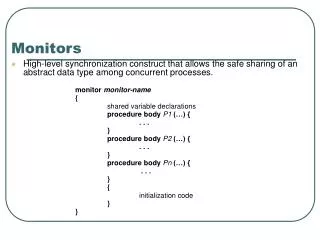
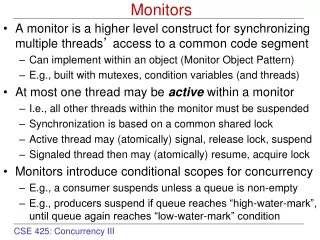
Monitors • A monitor is a higher level construct for synchronizing multiple threads’ access to a common code segment • Can implement within an object (Monitor Object Pattern) • E.g., built with mutexes, condition variables (and threads) • At most one thread may be active within a monitor • I.e., all other threads within the monitor must be suspended • Synchronization is based on a common shared lock • Active thread may (atomically) signal, release lock, suspend • Signaled thread then may (atomically) resume, acquire lock • Monitors introduce conditional scopes for concurrency • E.g., a consumer suspends unless a queue is non-empty • E.g., producers suspend if queue reaches “high-water-mark”, until queue again reaches “low-water-mark” condition
Desired Internal Behavior notify Queue empty - wait Queue
(Passive) Monitor Objects • “Monitor Object” Pattern Approach • Methods run in callers’ threads • Condition variables arbitrate use of a common shared lock • E.g., using a std::mutex, a std::unique_lock (must be able to unlock and re-lock it) and a std::condition_variable • Ensures incremental progress while avoiding race conditions • Threads wait on condition • Condition variable performs thread-safe lock/wait and wake/unlock operations • Thread released when it can proceed • E.g., when queue isn’t empty/full • Blocks caller until request can be handled, coordinates callers Client Proxy List (Monitor Object) add() Condition lookup() Lock
Can notify_one() or notify_all() If it doesn’t matter which thread, just wake one up If all need to see if it’s their turn, wake all of them Can limit waiting time Use wait_for() to return after a specified interval Use wait_until() to return at a specified time Can pass a predicate to wait (or wait_*) method(s) Won’t return until predicate is satisfied (or call times out) Helps to avoid spurious wake cases A Few Variations
Today’s Studio Exercises • We’ll code up ideas from Scott Chapter 12.4 to 12.4.3 • Again via C++11 concurrency/synchronization types/features • Looking at higher-level concurrency/synchronization ideas like condition variables being used to implement monitors • Today’s exercises are again in C++ • Please take advantage of the on-line tutorial and reference manual pages that are linked on the course web site • The provided Makefile also may be helpful • As always, please ask us for help as needed • When done send email with your answers to the cse425@seas.wustl.edu account with subject line “Concurrency Studio III”