Understanding Distance and Pythagorean Theorem in Geometry
This lesson focuses on the Distance Formula and the Pythagorean Theorem, vital concepts in geometry. Students will learn to calculate distances between points in the coordinate plane. The lesson includes example problems and word problems involving real-life applications. Learners will practice rounding their answers to the nearest tenths and hundredths. Through classwork and homework assignments, students will solidify their understanding of parallel and perpendicular line segments while also exploring the properties of quadrilaterals and the relationships of their slopes.

Understanding Distance and Pythagorean Theorem in Geometry
E N D
Presentation Transcript
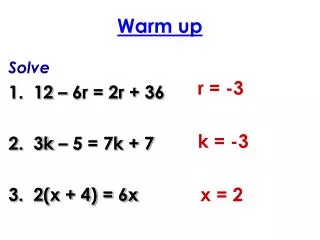
Warm up Solve 1. 12 – 6r = 2r + 36 2. 3k – 5 = 7k + 7 3. 2(x + 4) = 6x r = -3 k = -3 x = 2
Example Find the distance between (1, 4) and (-2, 3). Round to the nearest hundredths. D = 3.16
Example Find the distance between the points, (10, 5) and (40, 45). Round to the nearest hundredths. D = 50
3. Find the distance between the points. Round to the nearest tenths. 3.6
4. Find the distance between the points. Round to the nearest tenths. 3.2
Pythagorean Theorem Word Problems • A square has a diagonal with length of 20 cm. What is the measure of each side? Round to the nearest tenths. x = 14.1 cm
Pythagorean Theorem Word Problems • A 25 foot ladder is leaning against a building. The foot of the ladder is 15 feet from the base of the building. How high is the top of the ladder along the building? Round to the nearest tenths. x = 20 ft
Pythagorean Theorem Word Problems • Ashley travels 42 miles east, then 19 miles south. How far is Ashley from the starting point? Round to the nearest tenths. x = 46.1 miles
Pythagorean Theorem Word Problems • What is the length of the altitude of an equilateral triangle if a side is 12 cm? Round to the nearest tenths. x = 10.4 cm
ClassworkRound to the nearest tenths. Worksheet
Conclusions Parallel • Same slope means sides are parallel • Opposite reciprocal slopes mean perpendicular segments (90) Distance • Same distance means segments are congruent