Understanding Continuity in Functions: Definitions and Types of Discontinuity
This guide explores the concept of continuity in functions, defining when a function is considered continuous. It discusses the three types of discontinuity: removable, infinite, and jump discontinuities. The criteria for continuity on a closed interval [a, b] is examined, along with applications of the Intermediate Value Theorem (IVT). Examples are provided to demonstrate how to identify discontinuities and prove continuity on specific intervals. Gain insights into function behavior and how to find roots within given intervals.

Understanding Continuity in Functions: Definitions and Types of Discontinuity
E N D
Presentation Transcript
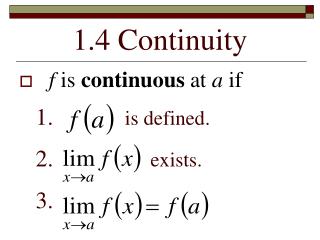
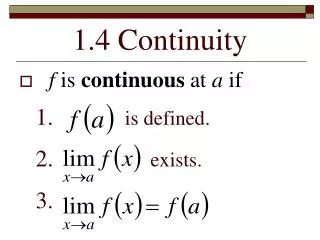
1.4 Continuity • f is continuous at a if • is defined. • exists.
Ex 1: Discontinuous where & why? *see graph.
1.4 Continuity • 3 types of discontinuity: • Removable • Infinite • Jump
Continuity on a Closed Interval • f is continuous on [a,b] if it is continuous on (a, b) and:
The Intermediate Value Theorem (IVT): If f is continuous on the interval [a, b] and k is any number between f(a) & f(b), then there exists a number c in (a, b) such that f(c) = k.
Ex 5: Show that the equation has a root in the interval [1, 2]
1.4 pg. 781 – 5 odds,7 – 23 EOO,25 – 31 odds,33 – 53 EOO,57, 59, 75, 77, 8523 Total