Understanding Corrosion and Electrochemistry in Metal Reactivity
Learn about the process of corrosion and its link to Friday's lab, explore the activity series of metals, understand electronegativity, and delve into electrochemistry and galvanic cells.

Understanding Corrosion and Electrochemistry in Metal Reactivity
E N D
Presentation Transcript
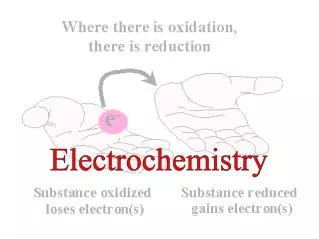
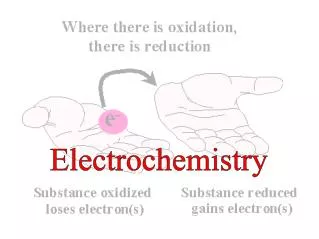
Pgs. 652 - 654 Electrochemistry
How does our lab from Friday link to corrosion? • Corrosion is the process of returning metals to their natural state • It’s a REDOX reaction!! Fe (s) + O2 (g) Fe2O3 (s)
LOTS of metals corrode, but not all of them corrode to the same extent: • Ex Aluminum!! • Aluminum will be oxidized by the air • Al (s) + O2 (g) Al2O3 (s) • A thin layer of Al2O3 will cover the metal and protect it from further corrosion
How can we protect these metals from corrosion? • The Mg will react instead of the iron…but why???
So what does this have to do with the lab?? • It all comes down to HOW ACTIVE a metal is!! • What was the most active metal you saw in the lab? • What was the least active metal? • What does it all mean???
Most reactive Activity Series How does electronegativity relate? Least reactive Li Rb K CsBa Sr Ca Na Mg Al Zn Cr Fe Ni Sn Pb Cu Hg Ag Au
How does electronegativity relate? More electronegative = more you “love” electrons = more likely to ________ Electronegativity = how much you “love” electrons
Most reactive Activity Series Let’s look at Mg and Cu: Mg + CuCl2 Cu + MgCl2 Cu + MgCl2 Mg + Cu Cl2 For a reaction to happen the solid metal must be above the aqueous metal in the activity series Least reactive Li Rb K CsBa Sr Ca Na Mg Al Zn Cr Fe Ni Sn Pb Cu Hg Ag Au
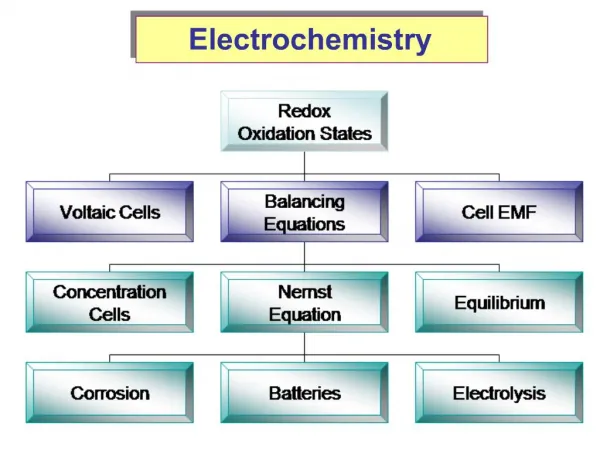
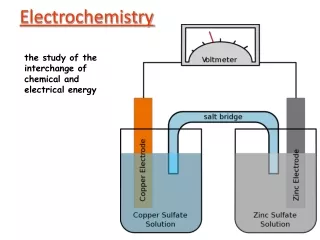
Electrochemistry • The study of the interchange of chemical and electrical energy • Two types of processes in electrochemistry: • The production of an electric current from a chemical (redox) reaction • The use of an electric current to produce a chemical change
But first, a demo review from yesterday… • When iron metal is dipped into an aqueous solution of blue copper sulfate, the iron becomes copper plated • Why? • The iron loses e- to the copper • What type of reaction is this???? Fe(s) + Cu2+(aq) Fe2+(aq) + Cu (s)
Fe FeSO4(aq) CuSO4(aq) Zn Copper Plating – An Example Fe Cu Since the copper is plating the iron, the solution will get lighter as more copper is used.
Does the reverse happen? Fe(s) + Cu2+(aq) Fe3+(aq) + Cu (s) Can we go backwards?…. Fe(s) + Cu2+(aq) Fe3+(aq) + Cu (s) • Some metals are better reducing agents than others • (AKA: some metals lose e- easier than others.) • The reaction is only spontaneous one way… the reverse reaction requires an outside source of energy to work.
What does all of this mean? • To capture the electrical energy, the two half-reactions must be physically separated • Called electrochemical cells • Can create electricity or be used to create a chemical change!!
Galvanic Cells • Invented by Alessandro Volta in 1800 • Galvanic cells: electrochemical cells used to convert chemical energy into electrical energy • Examples alkaline batteries • Made of half cells • One part of the galvanic cell where oxidation or reduction is occurring
Schematic for separating the oxidizing and reducing agents in a redox reaction. Cu2+ Cu2+ + 2e- Cu Fe2+ Fe3+ + e-
Why won’t the reaction continue?? Build up of charges would require large amounts of energy Solutions must be connected to allow ions to flow! Cu2+ + 2e- Cu Fe2+ Fe3+ + e-
Salt Bridge: contains a strong electrolyte held in place by gel Porous Disk: allows ion flow without mixing solutions Allows ions to pass between solutions, but doesn’t allow the solutions to mix
Parts of a Galvanic Cell • Electrode: • Conductor in a circuit that carries electrons to a metal • Anode = oxidation • Negatively charged • Cathode = reduction • Positively charged
Steps of a Galvanic Cell • e- created at anode • Shown in oxidation half-reaction • e- leave zinc and pass through wire • e- enter cathode and cause reduction • Shown in half-reaction • Positive and negative ions pass through salt bridge to finish the circuit
Oxidation half-reaction Zn(s) Zn2+(aq) + 2e- Reduction half-reaction Cu2+(aq) + 2e-C Cu(s) Overall (cell) reaction Zn(s) + Cu2+(aq) Zn2+(aq) + Cu(s) A galvanic cell based on the zinc-copper reaction. Figure 21.5
Schematic of a battery. Electron flow anode to cathode (- to +) oxidation to reduction reducing agent to oxidizing agent
Let’s practice drawing a Cu/Zn Galvanic Cell • Cu2+ + 2e- Cu Cathode/reduction • Zn Zn2+ + 2e- Anode/oxidation • Cu2+ + Zn Zn2+ + Cu Cu Zn SO42- Zn2+
Voltaic Cell Shorthand • Oxidation half cell is listed first with reduced and oxidized species separated by a line. • Reduction is next in the opposite order. • Double line separates the two and represents a salt bridge and electron transfer: Zn|Zn2+||Cu2+|Cu
Voltaic Cell Shorthand • Draw shorthand notation for a Mg-Pb cell where the nitrate ion is present. You might want to refer to the activity series to determine what is oxidized and what is reduced! • Draw a diagram for this galvanic cell on the scratch paper provided! • Label: anode, cathode, direction of e- flow • Write-out the ½ rxns and combined reaction.