NPS and Caffeine
170 likes | 308 Vues
This paper explores the antagonistic relationship between caffeine and neuropeptide S (NPS), highlighting caffeine's role as a common stimulant that disrupts sleep patterns by increasing sleep latency, reducing total sleep time, and fragmenting sleep. It investigates caffeine's effects on rat and mouse models, demonstrating how caffeine treatment regulates the expression of the NPS system in the brain. The findings suggest intricate mechanisms involving adenosine receptors and the impact of NPS on arousal and locomotor activity, contributing to a deeper understanding of sleep regulation and behavioral responses.


NPS and Caffeine
E N D
Presentation Transcript
NPS and Caffeine A Sordid Tale of Antagonism
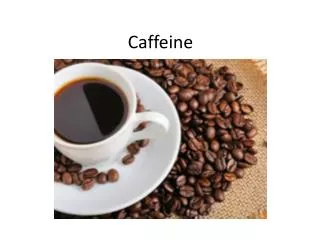
Caffeine • “Caffeine is the most commonly used stimulant to combat inappropriately timed sleepiness.” • Extends sleep latency • Decreases total sleep time • Increases sleep fragmentation • In rats, leads to reduced food intake leading to weight loss
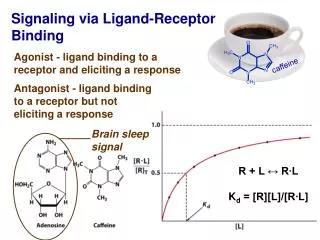
Proposed Mechanisms • Antagonist of the dopamine-adenosine interaction via adenosine A2A receptors (Gs cAMP) in striatum • Antagonism of the adenosine A1 receptor (Gi/o cAMP) of the basal forebrain neurons
Neuropeptide S • 20 Amino Acid Neuropeptide • Binds NPS-R (G-Protein coupled receptor) • Expressed located almost solely in the brain stem region close to the locus coeruleus and Barrington’s nucleus • Other areas of weak expression exist (dorsomedial nucleus of the hypothalamus and amygdala) • Sleep-wake cycle • Arousal • Locomotor activity • Feeding
Caffeine Treatment Regulates Neuropeptide S System Expression in the Rat Brain Lage et al. (2006) Neuroscience Letters 410: 47-51
The Experiment • Adulte male Sprague-Dawley rats • 12H Light-Dark • Doesn’t identify experimental timeframe • Studied the effects of acute and chronic caffeine treatment
Role of the Ecto-Nucleotideases in the Cooperative Effect of Adenosine and Neuropeptide-S on Locomotor Activity in Mice Pacheco et al. (2011) Pharmacology, Biochemistry and Behavior 99: 726-730
The Experiment • Male albino CF-1 mice • 12H Light-Dark • Experiments done in the light cycle >=[ • Investigated whether the involvement of adenosine in the hyperlocomotor effect of NPS is due to its production via ecto-nucleotidases pathway • Pre-treated mice with AOPCP (α,β-mehtylene-adenosine 5’-diphosphate), an ecto-5’-nucleotidase inhibitor • NPS challenge • Investigated whether NPS treatment is able to modify the E-NTPDase and ecto-5’-nucleotidase activities in hippocampal and striatal mouse brain slices
Modification of Caffeine Effects on the Affect-Modulated Startle by Neuropeptide S Receptor Gene Variation Domschke et al. (2012) Psychopharmacology 222: 533-541
The Experiment • 124 unrelated, healthy individuals • AA/AT/TT polymorphisms were determined • One-session, double-blind placebo controlled between-subject designed Caffeine challenge. • 24 each of unpleasant, neutral, and pleasant pictures were shown to subjects (sequentially for 8s intervals)