Download
1 / 22
250 likes | 589 Vues
This presentation by Brenda Marsteller-Kowalewski, Co-Director of the Community Involvement Center at Weber State University, offers an insightful overview of Community-Based Research (CBR). It explores the collaborative nature of CBR, contrasting it with traditional research methods. Key topics include the principles of practice, pedagogical methods, benefits and challenges, and examples from Weber State. CBR fosters the democratization of knowledge, emphasizing community involvement and social justice. Participants learn how to effectively engage in research that addresses pressing community issues.

E N D
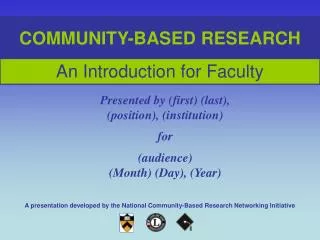
COMMUNITY-BASED RESEARCH An Introduction for Faculty Presented by Brenda Marsteller Kowalewski Community Involvement Center, Co-Director Weber State University for Teaching Learning Forum September 17, 2007 A presentation developed by the National Community-Based Research Networking Initiative
CBR: AN OVERVIEW • What is CBR? • Principles of Practice • How does it differ from traditional research? • Why do CBR? • Pedagogical Methods • Benefits & Challenges • What It Takes • Examples of CBR at WSU • Resources
CBR: WHAT IS IT? • A collaborative, participatory research process that embraces: • Research • Community has information needs • Campus partners have research tools and resources • Education • Community has valuable local knowledge & experience • Campus partners have theoretical and large scale perspectives • Action • Build organizational and community capacity • Effect policy change
CBR: Definition • “CBR is a partnership of students, faculty, and community members who collaboratively engage in research with the purpose of solving a pressing community problem or affecting social change” (Strand, et al., 2003).
CBR: Principles of CBR • CBR is a collaborative enterprise between researchers and community members. • CBR involves the democratization of knowledge • CBR has as its goal social action and social change for the purpose of achieving social justice (Strand et al., 2003: p. 8).
CBR: Collaboration • research with andfor the community. • community partners should be working with students and professors at every stage in the research process.
CBR: Democratization of Knowledge • knowledge brought to the project by all partners involved is equally valued • multiple research methods are used • user friendly approaches to the dissemination of knowledge are provided • conventional assumptions about knowledge itself are challenged
CBR: Social Change for Social Justice • produce information that can be used to bring about needed change • findings of the research or the process itself might contribute to social change
CBR: Vs. Traditional Research TraditionalCBR Goal of Research Advance Address knowledge social need advancement Source of Question Existing work Community identified need Designer/ResearcherTrained Trained • researcher researcher + students + comm. partner
CBR: Vs. Traditional Research TraditionalCBR Researcher Outside Collaborator Role expert Role of None or RA Partners Students Role of Subject to be Knowledgeable Community studied partner
CBR: Vs. Traditional Research TraditionalCBR Relationship of Short-term Long- Researcher & & detached term + Participantsconnected and multi- faceted Measure of value Acceptance by Usefulness to of the research academic peers partners (as well as publish)
CBR: Vs. Traditional Research TraditionalCBR MethodologyConform to Conform to Criteria/ rigor rigor Methods Objectivity & Open to positivistic new info. Researcher Flexibility control Quantitative Mixed
CBR: Vs. Traditional Research TraditionalCBR Beneficiaries Researcher, Researcher, Field students, & community “Owner” of Researcher Researcher, Research students, & community
CBR: Vs. Traditional Research TraditionalCBR Presentation &Articles, Articles, DisseminationConference Conference of Findings presentation, presentation, Books/Chapter Books/chapter Reports, Public meeting, Art work/media
CBR: WHY DO IT? • Complex social problems ill-suited to “outside expert” research alone • Impact community capacity • Build long-term relationship with community partners • Effective method of teaching and learning for all participants • The ultimate form of service-learning?
CBR: Ultimate S-L Experience • The quality of service-learning is enhanced through CBR in that it offers the most opportunities for: • collaboration • direct application of course content • potential for social change
CBR: PEDAGOGICAL METHODS • Course-based options model • CBR-based semester courses • Long-term, course-based projects • Interdisciplinary, multi-course collaborative projects
CBR: BENEFITS • Community • Access to faculty expertise • Organizational capacity building • Policy change • Students • Develop new skills • Improve existing skills • Connect classroom learning with real-world application • Faculty • Enhanced teaching credentials • New venues for publishing and presenting • Positively impact students and community
CBR: CHALLENGES • Unpredictability • Calendar conflicts • Role confusion • Participant compensation/ recognition
CBR: WHAT DOES IT TAKE? • Time • Long-term vision • Communication • Flexibility • Willingness to develop research process with community input
CBR: Examples at WSU • Lauren Fowler, Psychology • Bryan Dorsey, Geography
CBR: RESOURCES • National Community-Based Research Networking Initiativewww.cbrnet.org • CBR Course and Project Databasewww.bonner.org/campus/cbr/profiles.taf • Campus-Community Partnerships for Healthwww.ccph.info • Community-Based Research & Higher Education: Principles & PracticesStrand, Marullo, Cutforth, et. al.