Understanding Gerrymandering: Impact and Historical Origins
Gerrymandering refers to the intentional manipulation of congressional district boundaries to influence election outcomes. Originating from Massachusetts Governor Elbridge Gerry in 1812, who crafted a district resembling a salamander, this practice aims to either concentrate opposition votes (packing) or dilute minority strength (dilution). Congress regulated redistricting in 1967, mandating single-member districts. This article explores the implications of gerrymandering, its history, and questions its ethicality in contexts like Mississippi. How can states avoid accusations of racial gerrymandering?

Understanding Gerrymandering: Impact and Historical Origins
E N D
Presentation Transcript
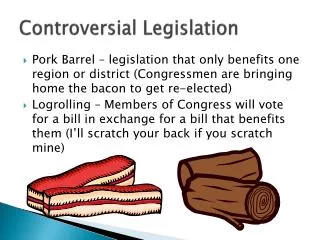
Controversial Legislation • Pork Barrel – legislation that only benefits one region or district (Congressmen are bringing home the bacon to get re-elected) • Logrolling – Members of Congress will vote for a bill in exchange for a bill that benefits them (I’ll scratch your back if you scratch mine)
What is it and where did it come from? • What is gerrymandering?Gerrymandering is a term that describes the deliberate rearrangement of the boundaries of congressional districts to influence the outcome of elections. • Where did gerrymandering come from?The original gerrymander was created in 1812 by Massachusetts’s governor Elbridge Gerry, who crafted a district for political purposes that looked like a salamander.
What’s the Point? • What is the purpose of gerrymandering?The purpose of gerrymandering is to either concentrate opposition votes into a few districts to gain more seats for the majority in surrounding districts (called packing), or to diffuse minority strength across many districts (called dilution). • How has Congress regulated redistricting?In 1967, Congress passed a law requiring all U.S. representatives to be elected from single member districts—the system we use today. All other redistricting regulations come from the states or the courts.
What do you think? • Is Mississippi an example of racial gerrymandering? Why or why not? • How can a state avoid being accused of racial gerrymandering?