Understanding Data Centricity: The Core of Modern Operational Efficiency
30 likes | 136 Vues
Data centricity places data at the heart of organizational functions, ensuring efficiency and accuracy across systems. With mandatory functions like FedBizOpps and DD350 relying on data, the automation of fields enhances operational workflow. This approach enables seamless data capture from users involved in packaging, transportation, and quality assurance. It fosters reviews, supports order modifications, and provides crucial data history for reporting, troubleshooting, and future evolution. Embracing data centricity is essential for thriving in today's data-driven world.


Understanding Data Centricity: The Core of Modern Operational Efficiency
E N D
Presentation Transcript
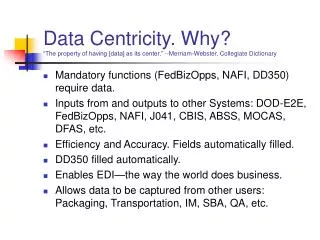
Data Centricity. Why?“The property of having [data] as its center.” --Merriam-Webster, Collegiate Dictionary • Mandatory functions (FedBizOpps, NAFI, DD350) require data. • Inputs from and outputs to other Systems: DOD-E2E, FedBizOpps, NAFI, J041, CBIS, ABSS, MOCAS, DFAS, etc. • Efficiency and Accuracy. Fields automatically filled. • DD350 filled automatically. • Enables EDI—the way the world does business. • Allows data to be captured from other users: Packaging, Transportation, IM, SBA, QA, etc.
Data Centricity (cont.) • Re-use--allows for import of documents, copying of line items. • Facilitates reviews. • Allows for orders and modifications. • Provides data history. • Allows for reporting: management, metrics, congressional inquiries, GAO, OSI, FOIA. • Facilitates troubleshooting. • Allows for future data evolution.
Data Centricity (cont.) We Knew It Was Coming!