Download
1 / 36
360 likes | 478 Vues
Discover the fascinating formation of our solar system through the Nebular Hypothesis, a widely accepted model proposed by Emanuel Swedenborg in 1734. This theory explains how a massive cloud of gas and dust underwent gravitational collapse to form the Sun and planets. As this primordial nebula contracted and spun, it flattened into a disk, leading to the creation of planetesimals and protoplanets. Explore the differences between inner terrestrial planets and outer gas giants, and learn about the solar system's age and characteristics shaped over 4.6 billion years.

E N D
Solar Nebular Hypothesis: Accretionary Disk Model How our solar system formed
Nebular Hypothesis • The most widely accepted model explaining the formation and evolution of the solar system. • Proposed in 1734 by Emanuel Swedenborg. • Also known as: Accretionary Disk Model
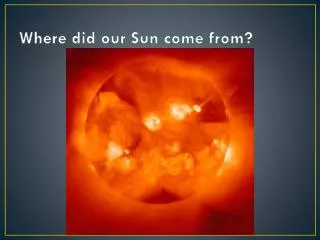
The beginning… • A large cloud of gas began to collapse under its own gravity becoming denser and hotter, forming a central star.
Formation of the planets • The cloud of gas and dust begins to contract (get smaller) and rotate more rapidly. • The cloud flattens into a pancake like disk.
Nebular Contraction • Why does it spin faster as it contracts?
Next… • Gases and dust grains in the original solar nebula begin to attract additional matter, forming clumps that rotate within the disk. • Accretion: gradual accumulation of mass.
Question: • Which object, a large or a small object, would accumulate more matter? Why?
Next… • Planetesimals formed (size of small moon) • Protoplanets formed (immature full scale planet • Then mature planets form.
So basically… • Our star formed at the center of this cloud of gas while the outer, cooler parts of the disk are where the planets were created.
Inner Planets vs. Outer Planets • Inner planets are small, solid and made with dense minerals. • Outer planets are large, mostly gas with a solid core.
Review: how the solar system formed Nebular theory / Accretionary model • Huge cloud of dust and gas • Begins to condense at center due to gravity • Some areas in cloud become concentrated by accretion (particles sticking together due to gravity) • Areas near sun high in heavier elements (form inner planets) • Areas far from sun low in heavy elements (form outer planets)
Solar System Characteristics • Gas Expulsion • Strong solar wind blew away any left over dust and gas. • Planetesimal Ejection • Uranus and Neptune pushed planetesimals out to the Kuiper Belt. • Jupiter and Saturn Kicked planetesimals out to the Oort cloud
Solar System Characteristics • Scientists believe the Solar system is at least 4.6 Billion years old! • Evidence: • Measuring rock age and composition on Moon, other moons, comets, asteroids, meteors • How big is our solar system? • Remember what an Astronomical Unit is? • Mercury is 0.39 AU from the sun. • Pluto is 39.5 AU from the sun.
Solar System Characteristics • We are approximately 27,000 ly away from the center of the Milky way galaxy.
Solar System Characteristics • Planets all orbit the Sun in the same direction: counterclockwise. This is the same direction as the sun rotates on its axis. • The orbits of almost all the planets all lie in nearly the same plane (the ecliptic plane) • Except: Mercury = 7; It is so close to the sun which exerts too much gravity causing it to orbit off of the ecliptic plane • Except: Pluto = 17; It is believed to be a satellite captured by the Suns gravity and not a planet that formed in the evolution of our star and solar system.
Mercury 7o 17o Pluto
2 Types of Planets • Terrestrial: • Inner planets • Mercury • Venus • Earth • Mars • Rocky • Denser • Smaller • Gas Giants (Jovian): • Outer planets • Jupiter • Saturn • Uranus • Neptune • Balls of gas • Less dense • Larger • Rings