Download
1 / 16
160 likes | 273 Vues
The GRAND (Gamma Ray Astrophysics at Notre Dame) array, established in 1996 north of the Notre Dame campus, was designed to investigate stellar point sources of gamma rays and analyze cosmic rays with energies between 100 TeV to 100,000 TeV. The array consists of 64 stations arranged in a grid, with advanced proportional wire chambers ensuring high detection accuracy. Despite its ambitious goals, moisture issues and funding challenges led to inactivity, halting extensive data collection. Efforts continue to secure private contributions for the project's revival.

E N D
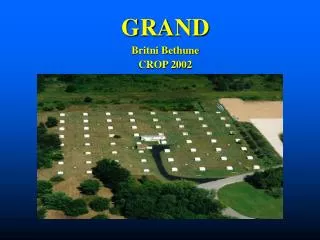
Gamma Ray Astrophysics at Notre Dame • The University of Notre Dame is located north of South Bend, Indiana • 150km from Chicago • (86o W, 42o N, 222m elevation) • The GRAND array was constructed on a field just north of campus; completed in the spring of 1996 • Building costs totaled over $1 million; funded by the National Science Foundation, Notre Dame, and private contributors
Purpose • Original purpose: study stellar point sources of gamma rays • This requires good angular resolution, good particle identification, adequate area, and sufficient running time to gather data • New primary goal: measure composition of cosmic rays in the energy range of 100 to 100,000 TeV
The Array • 100 x 100 meter field • 64 stations arranged in 8 x 8 grid; 14 meters separating them • First southwest quadrant of stations constructed 0.6m underground • Design purported for cooling in the summer • Led to moisture problems • Remaining stations built above ground
The Stations • 2.4m x 2.4m x 0.9m high huts • Heaters maintain temperatures > 17o C • Dehumidifiers maintain humidity < 55% • Each hut houses 8 planes of proportional wire chambers
Configuration of Detectors • Four pairs of PWCs stacked vertically and separated by 200mm • Each plane is 1.2m2 • 50mm thick steel absorber plate after top three pairs • Last pair identifies muons with 96% accuracy
Proportional Wire Chamber • First wire chamber: Geiger Muller counter, invented in 1908 • Metallic cylinder; Ionizing gas; High voltage anode wire along axis • When a particle passes through the cylinder • It ionizes gas molecules • Free electrons accelerate in electric field and produce secondary electrons • Electrons to anode wire; + ions to cylinder
Multiwire Proportional Chambers • Primary electrons drift to nearest anode wire • Avalanche begins about 50 μm from wire • Positive signal from cathode planes; Negative signal from anode wires • Cathode strips to anode wires can locate passage of particle in two dimensions (X and Y)
80% Argon 20% CO2 Gas bottles Central Data Acquisition Trailer
Data Systems • 80-cell planes • Each cell has amplifier, shift register, summer • Station triggers from 3-fold coincidence in X or Y signal from top 3 pairs • Trigger stores 640 cells of info in shift register memory
Data Acquisition System • Trailer coincidence circuit can be set for N simultaneous huts • Coincidence causes train of clock pulses to be sent to all stations • Data is shifted from stations to trailer in 70 microseconds • Trigger time, accurate to 1 millisecond, is recorded along with trigger data • Muon data processed separately (4-fold coincidences)
Setbacks • Moisture problem in southwest quadrant • Remainder of array built above ground • Ten stations flooded in summer of 1996 • Permanent drainage added on south and west • NSF decides it cannot afford to operate array • Major running expense: argon gas flowing through detectors ($200/week) • GRAND now seeking private contributions to be matched by university funding
Conclusions • GRAND was constructed to study cosmic rays with energies from 1014 to 1017 eV • Upon completion of the array, the NSF decided against further funding • GRAND is inactive and has yet to collect any extensive air shower data beyond preliminary testing • Sources: • http://www.nd.edu/~grand/index.html (GRAND homepage) • http://www.physik.unizh.ch/~twalter/diploma_thesis/node15.html (operational notes on PWCs)