Understanding Similar Triangles: Definitions, Properties, and Corresponding Parts
Triangles are considered similar when their corresponding angles are equal and their sides are in proportion, indicating they share the same shape despite differing sizes. Corresponding angles are positioned similarly in the triangles, while corresponding sides connect these angles and maintain proportional lengths. Care must be taken when identifying corresponding elements due to potential reorientations of the triangles. Master these concepts through practice exercises that reinforce the identification of corresponding angles and sides.

Understanding Similar Triangles: Definitions, Properties, and Corresponding Parts
E N D
Presentation Transcript
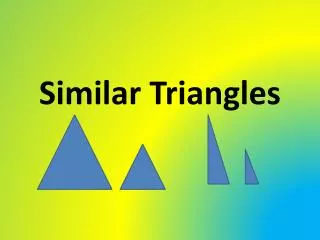
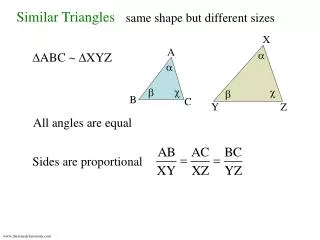
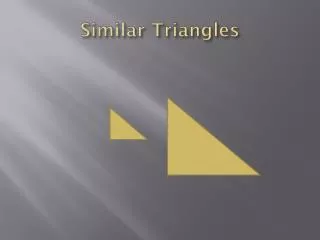
When are triangles considered similar? • Triangles are similar when: • their corresponding angles are equal • Their corresponding sides are in proportion to each other • They have the same shape, but are different sizes
What are corresponding angles? • Angles that correspond to each other are in the same relative position in similar triangles. • In the two triangles below, <K = <H, <L = <I and <M = <J
Don’t be fooled! • Be careful: triangles can be reversed in position – look carefully for the corresponding angles: r l ftm n • Can you name the corresponding angles???
Don’t be fooled! • Sometimes, triangles can be flipped and reversed! Can you still find the corresponding angles?
Don’t be fooled! • Sometimes, similar triangles can be hiding inside of each other. Can you still find the corresponding angles?
What are corresponding sides? • In the triangles below, the corresponding sides are the ones that are connecting the corresponding angles. They are in proportion to each other and have the same relative position. • So, ~ and ~ and ML ~
Corresponding sides • In similar triangles, corresponding sides are proportional. That means that they have been either enlarged or reduced by the same scale factor. • By what scale factor have the corresponding sides been reduced in the triangles below?
Corresponding sides • You can find missing side lengths in corresponding sides by setting up a ratio or proportion to solve: • = • By cross multiplying, x = 9
Homework: • Page 150 - 151 • #1, 2, 4, 5, 6, 7, 9, 10, 11