Recursive Descent Algorithm Limitations Explained
Understand the limitations of Recursive Descent Algorithm and compilers. Learn about the specific constraints and workarounds, with detailed examples for better comprehension.

Recursive Descent Algorithm Limitations Explained
E N D
Presentation Transcript
Recursive Descent Algorithm Limitations Compilers
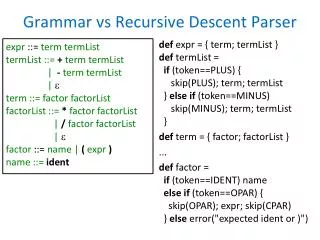
RDA Limitations E T |T + E T int | int * T | ( E ) bool term(TOKEN tok) { return *next++ == tok; } bool E1() { return T(); } bool E2() { return T() && term(PLUS) && E(); } bool E() {TOKEN *save = next; return (next = save, E1()) || (next = save, E2()); } bool T1() { return term(INT); } bool T2() { return term(INT) && term(TIMES) && T(); } bool T3() { return term(OPEN) && E() && term(CLOSE); } bool T() { TOKEN *save = next; return (next = save, T1()) || (next = save, T2()) || (next = save, T3()); }
RDA Limitations • If a production for non-terminal X succeeds • Cannot backtrack to try a different production for X later • Completely general recursive-descent algorithms support such “full” backtracking
RDA Limitations • Presented recursive descent algorithm is not general • But is easy to implement by hand • Is sufficient for grammars where for any non-terminal at most one production can match • The example grammar can be rewritten to work with the presented algorithm • By left factoring, the topic of a future video