Download
1 / 8
80 likes | 181 Vues
Learn about the effects of torque, rotational inertia, and conservation of energy in rotational motion. Discover how forces, torques, and work contribute to the dynamics of rotating objects. Explore the relationship between tangential force, acceleration, torque, and kinetic energy in rotating systems.

E N D
The Effect of Torque • A tangential force on a mass creates an acceleration. • Tangential force: Ft = mat • Tangential acceleration: at = ra • The force is associated with a torque. • Torque: t = rFt Ft r m
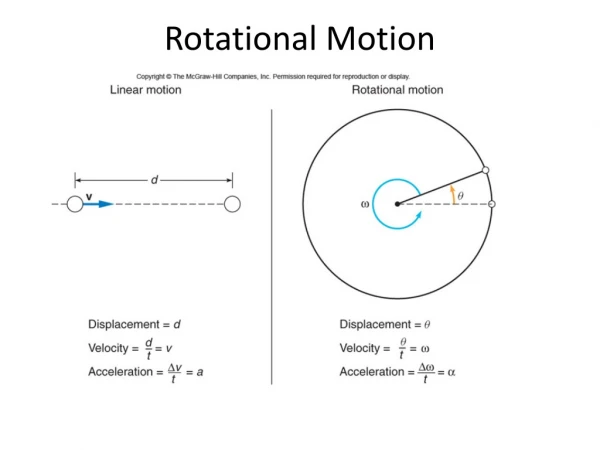
Rotational Law of Action • The force law can be combined with rotational motion. • Torque: t = rFt = r mat = m r2a • If torque replaces force, and angular acceleration replaces acceleration, this looks like the law of action.
Rotational Inertia • The term mr2 takes the place of mass in the rotational law of action. • This is called the rotational inertia or moment of inertia. • The symbol is I • For a single mass at a distance: I = mr2.
Pendulum Torque • The tangential force on a pendulum is due to gravity. • Ft = mg sinq • Tangential acceleration: • at = g sinq = La • a=g sinq / L • Torque: • t = rFt = mgL sinq • The torque is related to the moment of inertia. • I = t / a = (mgL sinq)/(g sinq / L) • I = mL2 L q Ft = mgsinq mg
Torque and Work • A force does work on an object acting over a distance. • A torque does work on an object rotating through an angle. r Dq
Conservation of Energy • The net work done by forces on an object equals the change in kinetic energy. • The net work done by torques on an object equals the change in rotational kinetic energy.
As with translational motion, power is the rate of work done. The earth is slowing due to the tides. About 28 s / century 1 part in 108 The kinetic energy is changing. DK = IwDw The power dissipation is large: About 7 billion hp Rotational Power next